
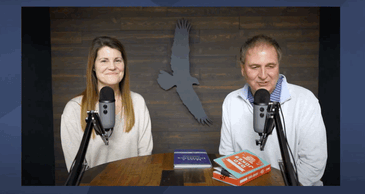
In this recent episode of Crossing The Line we discuss how to deal with the storms in our lives and in our relationships. Take a minute and listen to this short podcast. It could be just what you need.
[00:00:08] Hey everybody, this is Larry Little. And I'm Melissa Jackson. Thank you for joining us for Crossing the Line podcast where we talk about relationships and leadership and anything else that comes to our mind, Melissa. That's right. And one thing that is on my mind today is there has been, what I hear, a 40th anniversary of something that we must talk about.
[00:00:31] Yes, I got married when I was 12. And so I was a child groom. What state was that? No, we were very blessed to celebrate 40 years. Congratulations. That's a long time. Such a milestone. It's a long time. Thank you.
[00:00:55] You know, it comes with a lot of work. People say, you know, how do you get to 40 or beyond? And I always say, because I've heard it said to me, 30 to 8, it takes work.
[00:01:09] And it does take work. It's a choice. Because the truth is, in any relationship, you're going to have adversity.
[00:01:16] I mean, you know this. Come on, you have an incredible preteen who's just hitting those adolescent years. And I bet you might have experienced a little adversity from time to time.
[00:01:29] Larry, we don't have much. I mean, I'm going to try really hard to speak to adversity.
[00:01:35] It's going to be difficult for you.
[00:01:36] But it's going to be really difficult for me.
[00:01:38] Yeah.
[00:01:39] The storm is constantly brewing. That's the key.
[00:01:43] Look into the horizon.
[00:01:45] That's right. That's right. That's right.
[00:01:48] Oh, that's great. The truth is, we all have adversity. We've all faced adversity.
[00:01:53] Yes, we do.
[00:01:54] I think the real question is, and what we want to talk about today is not, are you going to have storms in your life?
[00:02:00] That's not the question, right?
[00:02:01] The question is, how do we deal with the storms in our life?
[00:02:06] How do we succeed? Because you see some people deal with it, and they deal with it successfully.
[00:02:13] Not that it's not hard, but they have a different result than others who really deal with it in a tragic way.
[00:02:20] It totally just destroys their inner being, their soul, if you will, even.
[00:02:26] And so I thought we'd talk a little bit today on adversity and the storms in our lives.
[00:02:33] What do you think?
[00:02:33] I think it's a great point for us to lean into today because just like you're saying, everybody has something going on.
[00:02:42] There's something.
[00:02:43] In the economy, in your personal life, in your work life, there's always something to be working on or navigating through.
[00:02:52] And so I think where we can focus today, too, is how do we build that muscle for the storms that arise in our life?
[00:03:00] What can we learn from the past?
[00:03:03] What can we do differently?
[00:03:05] How can we educate ourselves and really use our experience to help us for storms for the future?
[00:03:11] And when I think about that, how are we building resilience?
[00:03:15] How are we building resilience in those opportunities?
[00:03:17] Well, you have just articulated what I think the key ingredient is when you talk about storms.
[00:03:23] It's the key factor, if you will, in successfully navigating adversity, and that is resilience.
[00:03:30] You know, that's what I was talking about earlier, kind of.
[00:03:32] Some people have it, some people don't, right?
[00:03:34] And I think the first thing we have to do is define it.
[00:03:37] So in my mind, resilience is the ability to cope, the ability to push through, if you will,
[00:03:46] the ability to at some point recover from hard things, from adversity, from things that are storms in our life.
[00:03:56] I'd love your thought on that.
[00:03:58] I think so, and I think that we have to be careful that we don't think we're born with it.
[00:04:03] You know, we don't think it's just something we have or we don't have,
[00:04:07] that it's something that we can be intentional about to learn how to develop a muscle in that.
[00:04:12] It's kind of like, you know, you work out, right?
[00:04:15] You have this pattern of behavior that you spend energy time and you work out.
[00:04:21] And because of that, you know, it helps you in life, right?
[00:04:25] You feel good physically.
[00:04:29] You know, there are things that it produces in you.
[00:04:31] And so building that muscle for resilience means that we've got to do some things to develop ourselves
[00:04:39] and develop the ability to be resilient.
[00:04:43] You know, it may not be natural for us.
[00:04:44] It may not be something that just happens without us thinking.
[00:04:48] But we can learn how to be resilient and we can help teach other people how to do that
[00:04:55] and learn from each other and really kind of grow that muscle
[00:04:59] so that we can approach situations in a different light.
[00:05:03] No, you're just spot on.
[00:05:05] I think we fall into the mindset sometimes that it cannot,
[00:05:09] resilience, either you have it or you don't.
[00:05:11] You know, she's strong or she's not.
[00:05:12] No, no, no.
[00:05:13] This can be learned.
[00:05:14] This is a muscle, just like you said, that we can work on.
[00:05:17] And I think that's a really good assessment.
[00:05:20] So let's kind of, if we can, dig into resilience
[00:05:25] and let's explore what are some of the qualities that those who exhibit resilience have.
[00:05:31] Let's start there and then we'll end up with some really practical tools
[00:05:35] for people to use in building resistance.
[00:05:37] But I think as we look at what does resilience look like,
[00:05:39] I think one of the things, one of the qualities that people who have resilience have
[00:05:44] is the ability to accept what they can control, right?
[00:05:51] And not control what you can't control.
[00:05:54] I'll give you a very personal example of this.
[00:05:58] Four years ago, I lost my best friend.
[00:06:02] Tragic.
[00:06:03] We were supposed to go to the movies one afternoon.
[00:06:05] Before we could get there, he died of a heart attack.
[00:06:07] 30 years of friendship.
[00:06:11] And as I think about that, it's not about believing that I can change and bring him back.
[00:06:19] That's not what this is.
[00:06:20] It's about understanding what I can control in this situation.
[00:06:23] And that is how I walk through the grief.
[00:06:25] That is how I continue to put one step in front of the other.
[00:06:29] And I do not let this skew who I am as a person.
[00:06:33] But instead, I realize there are things I can control.
[00:06:36] I can learn.
[00:06:37] I can glean.
[00:06:38] I can take away.
[00:06:39] I can remember.
[00:06:40] I can grieve.
[00:06:41] Those things, for me to be intentional about that gives me resilience
[00:06:45] because it gives me purpose.
[00:06:47] Does that make sense?
[00:06:48] Yeah.
[00:06:48] And sometimes that's confusing.
[00:06:50] Sometimes we get mixed up with what we can control and what we can't control.
[00:06:55] Sometimes we forget.
[00:06:56] We just get in the mode and we get in such a reaction mode that we don't remember,
[00:07:02] hey, slow down.
[00:07:03] I can make a choice.
[00:07:04] I can step back and I can choose my response.
[00:07:08] And to be able to keep that at the forefront of what can I control?
[00:07:13] Right.
[00:07:14] You know, I can control how I respond to things.
[00:07:18] Then that will put me more in a driver's seat.
[00:07:20] Right.
[00:07:21] To be able to make things a choice instead of reacting.
[00:07:25] Yeah.
[00:07:26] It gives you the ability to continue.
[00:07:29] The ability for purpose.
[00:07:31] And another thing I think is really important I want you to speak to is reframing.
[00:07:36] There's a lot of data out there on that, but reframing those hardships.
[00:07:42] Speak to that just a minute.
[00:07:43] You know, losing a best friend and somebody that's like a brother is a very, very difficult,
[00:07:52] very difficult journey.
[00:07:54] And like you said, you can't change that.
[00:07:58] You can't make that a different situation.
[00:08:01] And so, you know, being able to understand where you are, what you think, how you feel about a situation.
[00:08:13] I think that a circumstance, something that happens is part of being able to work the process to get to reframing.
[00:08:22] I think if you try to reframe before you do the work on being able to hurt and be angry and deal with and walk through and getting to a place,
[00:08:40] reframing is this place of, you know, I'm going to allow myself to begin to accept some different ways of thinking.
[00:08:51] I'm going to take this situation.
[00:08:54] I'm going to accept it for what it is.
[00:08:57] And I'm going to begin allowing myself to see a different side, a different edge of the situation.
[00:09:05] I'm going to allow myself to kind of tear it down so I can build it back differently.
[00:09:11] That's good.
[00:09:12] I can frame it differently.
[00:09:14] And in doing that, I can begin to set up a different thought process.
[00:09:20] You know, I love that, but it comes with a warning and you mentioned it just a minute ago.
[00:09:25] If we start reframing before we really walk through the reality, then it seems to invalidate that process a bit.
[00:09:33] It seems, in other words, if I reframe too quick, I haven't allowed myself to walk through this appropriately or grieve or feel or whatever.
[00:09:40] But it's important to, and we'll talk about it in just a minute, it's important to feel those things.
[00:09:45] But it's also important to move forward.
[00:09:49] But I think before we move forward, like you said, before we can reframe, we have to make sure what can I control?
[00:09:55] What am I looking at?
[00:09:56] How do I need to grieve?
[00:09:57] Then now, okay, here's reality.
[00:10:00] I'm grieving.
[00:10:01] Reframing.
[00:10:01] Because a crucial part of reframing is emotional regulation.
[00:10:06] And that means now I can give validity to what I've walked through, what I've felt, right?
[00:10:12] But I don't have to stay there.
[00:10:13] I can reframe and I can regulate.
[00:10:15] I used to say I can put that in a box if I need to and open that box when I want to.
[00:10:21] So I think that's very important to understand emotional regulation doesn't mean I don't have the feeling.
[00:10:29] It doesn't mean that I have to try not to feel.
[00:10:32] It means that I have to realize that I cannot allow that emotion to drive my behavior,
[00:10:37] that I have to choose to experience that emotion when it's appropriate.
[00:10:44] And when it's not, I don't allow it to drive me.
[00:10:47] And if we don't walk through that process, we really can't reframe something so that we can regulate our emotion.
[00:10:54] What typically happens is we work to kind of push it in and then it comes out in other areas.
[00:11:00] Things that normally don't create frustration for us make us extremely angry.
[00:11:05] Or we find ourselves feeling numb.
[00:11:08] And so you can't regulate if we're not doing the work behind the scenes to really get there and become, you know,
[00:11:17] put the dial on the valve so we can turn it up and turn it down as we see that we need to.
[00:11:25] Part of that, part of a component to do that, when we work, you know, on those things,
[00:11:30] is getting to a place where, you know, I let go of this in order to open my hand up for something new.
[00:11:40] I open myself up for something new.
[00:11:42] Research shows and research, there's so much research out there that talks about leaning into gratitude.
[00:11:49] You know, leaning into balancing our mind from the storm into, you know,
[00:11:57] what is some hope that we have?
[00:11:58] What is something, what are the things that are going good in our life?
[00:12:02] Where can we find some gratitude of some things that we have experienced in our relationships?
[00:12:09] Moments, remembering opportunities that we can be thankful for.
[00:12:15] We really can change the chemistry, the dynamic that's going on in our brain
[00:12:20] when we allow ourselves to lean into some gratitude.
[00:12:27] We may not feel like it, but maybe choosing to get there where I begin to find,
[00:12:33] you know, I'm thankful for the memories.
[00:12:36] That's right.
[00:12:36] I'm thankful for the relationship that I shared.
[00:12:38] I'm thankful for, you know, where I am and that I had that opportunity.
[00:12:44] But finding those moments of gratitude.
[00:12:46] You know, it doesn't just sound good.
[00:12:50] This isn't just something you're saying.
[00:12:52] It's really backed up by data.
[00:12:53] There was some research done by the Walsh Group.
[00:12:56] And they did a study around people who were able to show resilience
[00:13:01] and walk through adversity successfully.
[00:13:03] When I say successfully, they come out on the other end.
[00:13:05] And what they found was that these people exhibited a positive, hopeful outlook.
[00:13:11] And they had a spirituality that gave them,
[00:13:13] you talked about that hand open with hope,
[00:13:15] but the gratitude, being positive, showing gratitude, and being hopeful.
[00:13:21] Those are incredibly important attributes.
[00:13:24] So that gratitude piece, you said it, it does change the chemistry of our brain.
[00:13:29] But it's not just a soft skill.
[00:13:31] I mean, sometimes we have to choose to be grateful
[00:13:33] when we don't even feel like being grateful.
[00:13:35] But boy, it has profound effects on us, I think.
[00:13:38] And I think the last quality that we want to talk about is,
[00:13:41] you know, you got to know when to ask for help.
[00:13:42] You got to know when to go to your pastor, go to a counselor, a professional,
[00:13:46] and seek help, right?
[00:13:48] When it gets to the point where you're like, you know, I'm not moving forward.
[00:13:51] I'm not able to reframe.
[00:13:52] I'm not able to show gratitude.
[00:13:55] And, you know, you're stuck.
[00:13:57] So if you know you're stuck, you know, we want to encourage you always
[00:14:00] to go and reach out for help.
[00:14:03] So with that being said, let's wrap this up.
[00:14:07] Because we need some practical tools.
[00:14:08] Melissa, how do we gain resilience when walking through the storms in our life?
[00:14:13] We need to talk about a few tools.
[00:14:16] So I want us to take a minute.
[00:14:18] Here are the tools that I think, and you and I have used these tools for a long time.
[00:14:24] So this is not something that we're just giving you that we hope it works.
[00:14:28] We practice it.
[00:14:29] We use it.
[00:14:30] It's a real deal.
[00:14:31] And there are three things.
[00:14:33] We call them AAA.
[00:14:34] We've called them AAA for years.
[00:14:37] It's a cognitive approach to resilience.
[00:14:40] But it really works.
[00:14:42] The three A's are be aware, and then analyze, and then act.
[00:14:48] So I want you to speak into that, if you will.
[00:14:51] We'll start with aware.
[00:14:52] What are we talking about?
[00:14:54] So it's that clearly what the word says.
[00:14:57] You know, it's being aware, slowing down so that you can be aware of yourself.
[00:15:01] You know, when we're in such a go mode, we don't really take the time to, and the environment doesn't produce that for us, to slow down and really be aware of what am I thinking?
[00:15:14] What am I feeling?
[00:15:15] You know, I find myself.
[00:15:17] Things happen throughout the day.
[00:15:19] Things happen at home.
[00:15:20] And I need a minute to step out of the situation to be able to really process.
[00:15:25] I move through it quickly.
[00:15:28] I need a moment to slow down, have a moment to process what did I think about that situation?
[00:15:35] Now, and how did I feel about that situation?
[00:15:37] And what do I need to, you know, how do I need to take that and kind of hone in?
[00:15:42] And what was that other person maybe thinking?
[00:15:45] What were they maybe walking through?
[00:15:48] So it's creating the moments to have some keen thought, emotion, recognition of what was going on.
[00:16:02] I have to slow down to do that.
[00:16:03] I know I'm a fixer, and I want to move from one thing to another.
[00:16:06] And maybe many of you listening are that way as well.
[00:16:09] And I find myself at times not being aware because not slowing down to be aware of my own thought process, my own feelings,
[00:16:17] my own thought, what is actually happening.
[00:16:19] And it's so powerful when we remember, whoa, whoa, whoa.
[00:16:22] You can choose to slow down.
[00:16:25] You can choose to be aware.
[00:16:26] Yeah, and sometimes maybe you're on the end where you're too aware.
[00:16:29] Maybe you're misreading things.
[00:16:31] Maybe you're miscalculating things.
[00:16:32] Maybe you're in tune so much that, you know, you're not really giving yourself some good boundaries
[00:16:39] to be able to step out and assess is your awareness correct?
[00:16:45] Is it accurate?
[00:16:46] Yeah, that's good.
[00:16:46] So there's different ends of that for people to be mindful of.
[00:16:49] So once we're aware, then we analyze.
[00:16:52] What are we analyzing?
[00:16:53] Talk about that.
[00:16:54] And we're kind of spoke to that just as we're talking here.
[00:16:57] We, you know, being analyzing your thoughts, analyzing your feelings, using EQ.
[00:17:06] When you analyze, we're not just talking about, you know, being logical, being analytical.
[00:17:12] We're talking about using the situation, using your logic and connecting to your emotion.
[00:17:22] And so you're looking at both.
[00:17:23] You're using EQ here.
[00:17:25] You're really allowing yourself to not just think about the dynamic, think about what happened,
[00:17:32] but you're thinking about how it happened and why it happened and spend some energy there.
[00:17:38] So for me, that looks like analyzing the options, analyzing the opportunities, analyzing problem solving,
[00:17:45] all of that.
[00:17:46] I have to slow down to think about, which gives me really control about how, instead of reacting,
[00:17:51] it allows me to respond because I'm analyzing, which leads us to that final A, act.
[00:17:56] Talk about that.
[00:17:57] An act is the action.
[00:17:59] What behavior are you choosing?
[00:18:01] How are you responding?
[00:18:04] How are you going to act?
[00:18:05] How are you responding to that?
[00:18:06] I get a chance to set up my response.
[00:18:08] I get a chance to go back and have a different level of conversation with that person.
[00:18:15] I get an opportunity to go back and say, I'm sorry.
[00:18:18] I get an opportunity to go back and pick up the con.
[00:18:21] What is my action?
[00:18:22] You know, what am I choosing to do?
[00:18:25] Because I've had an opportunity to be aware.
[00:18:28] I've had an opportunity to analyze what I want to do.
[00:18:31] And then I go do it.
[00:18:32] mm-hmm i'm gonna give us some we're running out of time we'll give us a just a quick uh a quick
[00:18:37] illustration of our triple a okay and and it's a very light silly illustration but but doggone if
[00:18:42] it didn't work um we had a we had a storm this week at our house i mean it was it was this weekend
[00:18:49] we lost the cat we had been doing in and out all the time the cat got lost and we didn't know where
[00:18:54] the cat we we thought my goodness we spent we were combing the house we're combing the woods
[00:18:59] we're trying to find the cat and and we're all it's been a long day i'm tired i'm worn out but i but
[00:19:05] i thought about this and i just stopped i literally said wait a minute and i went and sat down lissa i
[00:19:11] sat down in my chair and i said all right let's think about this for a minute where could that cat
[00:19:18] be and i analyzed all the options we've looked here we've looked i knew where we looked i knew his
[00:19:23] behavior i knew what he did and didn't like and i thought where and it came to me i'm telling you
[00:19:28] it came to me just crystal clear i'm sitting there i'm quiet for a minute instead of up and down running
[00:19:33] trying to fix it i'm i'm trying to be aware and i'm analyzing and i'm analyzing and it came to me
[00:19:39] go look under the bed so i used i acted i jumped up i went i looked under the bed and guess where the
[00:19:47] cat was right there under the bed under the bed so triple a can be used on an everyday basis for
[00:19:54] silly things but it can also be used for serious things and i've used that method i know you have to
[00:19:59] on more important storms in our life or more or larger storms if you will so i hope that if you're
[00:20:07] listening you can use this triple a aware analyze and then act to help you to build your resilient
[00:20:13] muscle it is investing it is working it is trying and learning and growing and getting up and trying
[00:20:21] again but the good news about storms is resilience can be learned you can choose to grow your resilient
[00:20:27] muscle it's good it's good thank you for listening to us today i hope this has been helpful to you
[00:20:33] um before i let you go before we leave there's one important really this is the most important part of
[00:20:38] the podcast i think uh we want to i want to share my dad joke of the podcast are you ready for this
[00:20:47] one yes i'm so ready you are so gonna love this one i'm so ready and and robin our producer she's over
[00:20:53] there just anticipating this she gets so excited when i when i share this she just loves it okay
[00:20:57] all right you guys ready ready all right here we go what do you get when you cross a cow
[00:21:04] and a shark what do you get when you cross a cow and a shark
[00:21:12] you ready i don't know but i wouldn't want to milk it
[00:21:20] i love even robin's laughing on that one yeah use some triple a with that
[00:21:26] all right hey thank you so much for listening and laughing with us some today
[00:21:31] we do value you and hopefully we've been a bit helpful for you as you walk through the storms in
[00:21:37] your life thank you for making a difference in the lives of those you love live and lead
[00:21:42] we'll see you next time