
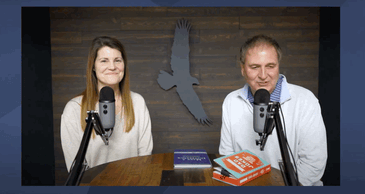
[00:00:09] Hey everybody, this is Larry Little. And I'm Melissa Jackson. And you're listening to Crossing the Line, a podcast where we talk about all kinds of things. We talk about relationships, we talk about leadership, we talk about communication. Hopefully, out of all the things that we talk about, Melissa, hopefully we're offering some help, just a few, just a bit, just some things that would help people in their everyday relationship life.
[00:00:33] Yes, I hope that we are, but we've left one thing out and that's football.
[00:00:38] Oh, it is football season. I'm so excited. I'm telling you, I've been waiting for this season. It's going to be good.
[00:00:46] Yeah, and what do you think about this season? With the SEC, it's going to look different, we're going to line differently. What do you think?
[00:00:53] Yeah, it really is. I'm an Auburn man, first and foremost, let me say that. And I think it's going to be very different. I'm excited about it, actually. We have two new teams in the SEC, Oklahoma and Texas.
[00:01:04] The divisions are gone. It's fun. Of course, as Auburn people, we have hope.
[00:01:12] Always hope. There's always hope.
[00:01:13] Our coach said, he said, this is a book and it's a new book and we're about to read the first chapter this year. So that's exciting for me. I'm looking forward to it.
[00:01:25] You know, it's just fun. It's something that every year rolls around. Sometimes I dread it.
[00:01:31] But this year, I'm looking forward to it. I think it'll be...
[00:01:35] We've got some hope.
[00:01:36] Yeah, we've got some hope.
[00:01:37] We've got hope.
[00:01:37] That's exactly right. But for now, we're talking about how do you talk to those you care about?
[00:01:45] How do you have a relationship that is good so you can enjoy your football season, if you're right?
[00:01:53] But what does that look like?
[00:01:56] Well, there's a stat out there by Vital Smart and it says that 72% of people avoid having meaningful conversation.
[00:02:06] So they avoid. They avoid talking about most things other than the weather or small talk and they kind of stay up on the surface.
[00:02:15] And there's good reason for that, I'm sure.
[00:02:17] Yeah, I think that is spot on. I think that stat is just spot on, maybe even a little low.
[00:02:23] People don't like to have those, not even deep. I think they just don't even like to have meaningful conversations sometimes.
[00:02:31] Well, there's so many differences, you know, in people and perspective.
[00:02:36] I mean, here we are in political season and, you know, there's so much going on that you don't want to step into land mines.
[00:02:42] You don't want to, you know, have an explosion of something.
[00:02:46] And so sometimes it's just nice to talk about the weather.
[00:02:49] It is. In fact, we're going to talk about that later in another podcast of families during this political season.
[00:02:56] You know, how do they get along? How do they have conversations?
[00:02:58] Because it is a landmine. He wants to go there.
[00:03:01] But I think in general, if you take that political season out of the mix, I think it's just difficult.
[00:03:07] We're so busy. We have so many things going on to make time to have those conversations that I think are really important to our relationships.
[00:03:19] Like a check-in. We're even talking about check-ins, right?
[00:03:22] How do you have relationship check-ins? How do you kind of check the temperature, see how things are going, see if everybody's in a good place overall?
[00:03:30] Relationally, we're, you know, connecting. We're feeling strong in our relationship.
[00:03:35] Yeah. And I think the key to that, you know, is really being intentional about it.
[00:03:42] But I've found that, you know, when I'm intentional about doing something, it's way more likely to happen than if I just, you know, say, well, I'll get to it when I get a chance.
[00:03:51] Or if I procrastinate or if I try to be spontaneous, let's just do it when it feels right.
[00:03:57] No. Having these conversations, you really have to choose to be intentional, I think.
[00:04:03] And I'm speaking from experience, right?
[00:04:05] And I know you had the same experience, but years ago, my children have grown, been married 40 years.
[00:04:12] We were in this thing where I was running, my wife was running, and my wife, and we'll talk about this in a minute, she's a camel.
[00:04:19] So she needed some structure.
[00:04:21] She needed some planning.
[00:04:23] She needed some organizing.
[00:04:24] Me, not so much.
[00:04:25] I didn't need it, but, you know, I just kind of did my thing.
[00:04:28] If I need you, I'll talk to you or we can talk on the run.
[00:04:31] And that didn't get it for her.
[00:04:33] No, no.
[00:04:33] So we set up what we call coffee time.
[00:04:37] And every Thursday, our kids who are adults, like I said, still talk about this because they knew I would drop them off at school and circle back around and go home.
[00:04:45] And we carved out coffee time every Thursday and for an hour.
[00:04:50] And we would sit, have coffee.
[00:04:53] And for her, the important conversation centered around scheduling and planning and logistics.
[00:05:00] And then if there were some issues that she needed to talk about, you know, we would.
[00:05:05] But generally, the vast majority of it was just planning so she would feel like she could gain control of her week, right?
[00:05:13] And it really changed our relationship in terms of communicating.
[00:05:18] And what I did find on that, Melissa, was that once I started it, she expected us to continue.
[00:05:27] And if I missed it, you know, it was no good.
[00:05:32] Yeah.
[00:05:33] Yeah.
[00:05:33] Well, I think those times are so important.
[00:05:35] You're talking about being intentional, putting on your calendar.
[00:05:38] We have something like that, too.
[00:05:40] So our daughter is a preteen.
[00:05:42] We're right knocking on the door of becoming an official teenager.
[00:05:46] And so, you know, life is busy.
[00:05:48] Lots of things going on during the day, in the evening.
[00:05:52] And so for us, evenings are hard.
[00:05:55] They're fast.
[00:05:56] You know, a lot to do, even to get ready for the next day to help us in the mornings.
[00:06:00] And so morning is our time, too, where we can get up early and have a moment when the house is still and calm and be able to check in and talk about something that was left undone from the day before.
[00:06:16] Be able to talk about the day ahead or the next few days, but be able to check on each other, check in, make sure we're doing well.
[00:06:25] Doesn't that send a message to the person you're in a relationship with that they're important?
[00:06:29] They're important enough for you to give them your time in the morning, that he's important enough for you guys to sit down and you to hear from him.
[00:06:37] And then he hears from you.
[00:06:39] I think there's some really good intangible things that happen in a relationship when we have these check ins.
[00:06:45] A lot of times you've got to get in the zone.
[00:06:47] You know, women are like spaghetti, you know, in their mind.
[00:06:51] And they have a lot of things going on and things around the house that need to get done.
[00:06:55] And so, you know, it's getting in that zone, too, where you can move into that place, slow down a bit, be able to connect, engage differently.
[00:07:04] So I want us to talk about some things that can be done to do that.
[00:07:09] How do we how do we make sure we're setting that up?
[00:07:13] And then let's talk about how we can do that for each personality so we can give some good tips, some tools so that each personality can we can talk specifically about things that meet their needs from a conversation standpoint.
[00:07:28] I think that's important.
[00:07:29] Now, there are two different things we need to be aware of.
[00:07:31] One is that this check in that is regular, like you're talking about in the mornings, like I did weekly.
[00:07:35] So so that's really important.
[00:07:37] That's that's what I call just the common check in time.
[00:07:40] There are other times we need a conversation when something comes up outside of that time and we need a conversation.
[00:07:47] We don't need to just do this as we're passing by.
[00:07:51] So many times we get into a little bit of trouble because we're maybe I'm ready to talk and I come in and I want to I want to spill the beans right now and just talk about things.
[00:07:59] And she's not ready.
[00:08:00] You know, she's not a good time.
[00:08:02] She's got to meet.
[00:08:02] Like you said, nights are hard.
[00:08:04] A lot of things going on.
[00:08:04] So there are two different situations we want to talk about.
[00:08:08] But but these things apply to both.
[00:08:10] Just know that you need both.
[00:08:12] You need that ongoing, regular time.
[00:08:14] But you also need to know what to do when you need to have a conversation that's not in that regular time.
[00:08:20] So I think the first thing is this.
[00:08:21] First, we need to be intentional about setting up the conversation.
[00:08:24] Right.
[00:08:25] So you just mentioned that we don't come off the cuff with it shooting from our hip.
[00:08:29] You know, maybe it's on our mind.
[00:08:30] We want to talk about it right now.
[00:08:32] I find myself doing that before I forget.
[00:08:35] You know, I want to have a conversation.
[00:08:36] But is it the right time?
[00:08:38] Does the situation allow for that?
[00:08:40] We're going to use some wisdom on knowing I might have to hold this and make sure we're setting up the best case scenario, the best time environment to be able to talk.
[00:08:50] You just said it.
[00:08:51] And that's the second thing.
[00:08:52] We've got to make the time.
[00:08:54] We've got to set aside that time and make it a priority because it's really important.
[00:09:00] Timing is everything in these conversations.
[00:09:02] So if we don't make the time, we don't make it happen.
[00:09:04] They won't happen.
[00:09:05] So it's it's setting up the conversation, but then making the time.
[00:09:08] Now, it's also knowing there's never going to be a perfect time.
[00:09:12] That's right.
[00:09:12] So good.
[00:09:13] That's right.
[00:09:13] You know, it's going to fall from the sky of here you have time and people are in the same mode.
[00:09:20] So that's not what we're talking about.
[00:09:22] Right.
[00:09:23] But being able to focus, it might even set you up to be able to say, hey, I do need to talk to you about a couple of things.
[00:09:32] And I need for us to find some time.
[00:09:34] When when can we have 15 minutes?
[00:09:35] That's it.
[00:09:36] So you're helping another person cue in.
[00:09:40] You're verbalizing.
[00:09:41] You're not stepping back and just waiting and finding the moment doesn't happen and being disappointed in that.
[00:09:48] Instead, you're helping get agreement, a time, a connection that'll work for both of you.
[00:09:54] And then as the old Nike commercial said, you may not even remember it.
[00:09:58] Just do it.
[00:09:59] Then just do it and make it happen.
[00:10:01] And you'll be so glad you did.
[00:10:02] You know, set it up, make the time and then just do it.
[00:10:08] Make it happen.
[00:10:08] You can set some parameters to that to help both of you know, what is this about?
[00:10:13] Is it just having conversation?
[00:10:15] Are we just checking?
[00:10:16] Are we just kind of getting a temperature gauge or read on things?
[00:10:20] There's no real action that needs to come from this.
[00:10:23] Or is there something that needs to take place from this conversation?
[00:10:27] You know, getting alignment so that there are good, solid expectations from where the conversation goes.
[00:10:34] All right.
[00:10:34] So let's talk about how to do it.
[00:10:36] How do we make these conversations successful?
[00:10:39] Because one size does not fit all.
[00:10:41] Right.
[00:10:42] I mentioned that a minute ago with our coffee time.
[00:10:44] It needed to look different for her personality.
[00:10:47] So let's jump into that.
[00:10:49] If you're setting these check-ins with lions, what does that need to look like?
[00:10:55] For lions, first of all, they're not going to need those probably.
[00:10:59] Or they're going to want to give you the bullet points.
[00:11:02] They do not need those.
[00:11:02] Really quickly.
[00:11:03] Let's move on.
[00:11:05] We connected, didn't we?
[00:11:06] We were in the same room, right?
[00:11:08] Hey, look.
[00:11:09] We got that task done.
[00:11:10] We connected.
[00:11:11] Let's go.
[00:11:12] So we're laughing here, but, you know, they're thinking make something quick.
[00:11:17] Make it easy.
[00:11:19] You know, don't expect a lot of deep conversation necessarily.
[00:11:24] How can we get to the point?
[00:11:27] Not beat around the bush.
[00:11:29] How can we talk about what you need to talk about?
[00:11:32] Or I need to talk about a couple of things.
[00:11:34] Here, it's one, two, three kind of thing.
[00:11:37] That's exactly right.
[00:11:37] I always say when you're doing this with lions, think in big rocks, talk in big rocks, and show respect for their time.
[00:11:44] When you do that, that sends a strong message to them that you have thought through what you're going to say.
[00:11:49] Big rocks.
[00:11:49] They don't need the details.
[00:11:51] And then let them go.
[00:11:52] Boy, that'll be effective if you're trying to reach the lion.
[00:11:56] Now, if you're a lion, you've got to realize that that's not what the other personalities need, and we'll talk about that in a minute.
[00:12:03] But quick, quick conversation.
[00:12:05] Getting to the point.
[00:12:06] Yeah, a quick example.
[00:12:08] My wife needed the meeting every week.
[00:12:11] I thought it would be a good idea to check in once a quarter or so.
[00:12:13] Once a quarter.
[00:12:14] No, no.
[00:12:16] She needed every week, and she needed planning and those kind of things.
[00:12:21] So just a difference of perspective, Melissa.
[00:12:24] Very much so.
[00:12:25] A difference of perspective.
[00:12:26] Well, let's talk about the monkeys when you're in a check-in with the monkeys.
[00:12:30] What does that look like?
[00:12:32] Monkeys value this conversation.
[00:12:34] You know, they really want you to set up an opportunity to talk.
[00:12:40] And it needs to be longer than, you know, a few minutes.
[00:12:43] You need to really carve out some time.
[00:12:46] Yeah.
[00:12:46] Because they're going to want to talk about, you know, the pieces connected to the pieces, you know, and what they experienced this week or yesterday.
[00:12:54] And, you know, really connect through that conversation.
[00:12:58] And that can go on, and it can go on, and it can go on.
[00:13:04] But it's connecting.
[00:13:06] Connecting and having fun.
[00:13:07] You wanted to butt in.
[00:13:08] I saw you.
[00:13:09] I did.
[00:13:09] I was trying to get on with it.
[00:13:10] Good night.
[00:13:11] That's right.
[00:13:12] And on.
[00:13:14] But monkeys need that.
[00:13:15] They need fun.
[00:13:16] Yeah.
[00:13:16] How are you feeling?
[00:13:17] How are you doing?
[00:13:18] They want to know, do you care about me first?
[00:13:20] And then we'll get to the agenda and things going on, right?
[00:13:23] They do want to tell you about it.
[00:13:24] They're interested in me.
[00:13:24] I want to know what happened to me today while I was at the grocery store.
[00:13:29] You know, come on.
[00:13:31] Can we move now?
[00:13:32] I'm not sure, but okay.
[00:13:36] All right.
[00:13:36] Let's go to those turtles.
[00:13:40] How do you have a check-in with a turtle, Melissa?
[00:13:44] I mean, it's going to take some time, right?
[00:13:46] It's not a drive-by.
[00:13:47] No.
[00:13:48] It's not a drive-by, Larry.
[00:13:51] You know, you have a turtle in your life.
[00:13:54] Educate us on what does a check-in really look like with that turtle?
[00:13:59] Oh, yes.
[00:14:01] You know, and he's a turtle camel.
[00:14:03] And he can kind of shift at times from each one of those modes.
[00:14:09] But the turtle side of him, he doesn't really want to talk.
[00:14:13] You know, he just wants to kind of be and just kind of sit and just kind of relax.
[00:14:19] And unfortunately, he doesn't get a lot of relaxing time at all.
[00:14:23] But the best case scenario is, you know, a time where he's got some energy, you know,
[00:14:30] and he's not worn out.
[00:14:32] And really carving that out so that we don't really have to talk about a lot of tactical things.
[00:14:41] You know, we can just kind of be a little bit.
[00:14:43] So it's conversation.
[00:14:45] But it's not the bullet points.
[00:14:48] It's not reviewing the tasks that need to get done around the home.
[00:14:52] Right.
[00:14:52] And you're about to fall asleep.
[00:14:56] You're killing me, Melissa.
[00:14:58] You're just killing me.
[00:15:01] Yeah, it's slowing down.
[00:15:02] It's really slowing down and being present.
[00:15:04] I love it.
[00:15:05] You know, one of the things that, and please comment on this, I think might be effective with turtles.
[00:15:09] Sometimes if it's something really important, write it down and let them have time to read it and then talk about it.
[00:15:15] Yeah, one thing is I really, you don't do this.
[00:15:19] We need to talk.
[00:15:20] That's not what you do.
[00:15:22] And leave it like that, right?
[00:15:25] It's not very kind.
[00:15:27] But giving them some warning, maybe put it in writing, giving them time to process, come back around, slowing down.
[00:15:34] And I guess sometimes is it just sitting together in quietness?
[00:15:39] Sometimes it's just relaxing together, being quiet and having a cup of coffee or whatever it may be.
[00:15:45] But just kind of being, kicking in neutral a little bit.
[00:15:49] Show some care by kicking it in neutral.
[00:15:52] Not very good at it, but that's good.
[00:15:53] That's a good word.
[00:15:55] Let's go to our camels.
[00:15:56] So tell us about them.
[00:15:58] Well, you have a camel.
[00:15:59] You can speak to this.
[00:16:00] I do.
[00:16:01] And when Kelly goes into camel mode at times, it is being able to know what they need to talk about, hitting the priorities of what's been on their mind because they've been processing for a while.
[00:16:17] And giving attention to the detail of the conversation, letting them have the space to be able to talk in the details.
[00:16:26] That honors them because you're getting in their zone and really hearing them.
[00:16:32] And you're giving them the attention.
[00:16:34] You're not on a device.
[00:16:36] Right.
[00:16:36] You're not doing something else, giving them your attention.
[00:16:40] So one of the things I've learned with my camel is that when we have these conversations, and we still do, we have this coffee time now.
[00:16:48] It's on Saturday morning.
[00:16:51] And when I make a comment, I better be darn accurate with what I say because she can fact check me like nobody's business.
[00:17:01] And it's like, yeah, I'm thinking about going down to Lowe's.
[00:17:05] I'm going to go around 10.
[00:17:07] Well, are you going at 5 till 10?
[00:17:08] Are you going at 5 after 10?
[00:17:09] No, no.
[00:17:10] Are you going to go at 10, 15?
[00:17:12] What do you mean by around 10?
[00:17:13] I'm like, I have no idea what I mean.
[00:17:16] And so one of the things that I've learned is when I have these conversations, try to be as accurate as possible and then let her ask questions around it.
[00:17:24] Oh, I have a funny on that one.
[00:17:26] So my daughter fact-checked my husband yesterday.
[00:17:30] They were talking about what time they left the location.
[00:17:34] And he said, you know, 4 after.
[00:17:36] And she said, no, it was 3.
[00:17:38] Oh, I have a funny story.
[00:17:41] So, you know, get those details straight, right?
[00:17:43] Get the details straight and let them ask where they love those questions.
[00:17:48] And I think it validates them in a way.
[00:17:52] And so what I have to work on is not to allow those questions to frustrate me, but to give those answers and to join in that conversation in that way.
[00:18:02] You know, it's important to understand who you are, what your strengths and weaknesses are in these conversations.
[00:18:08] But it's also important to know who those relationships are, what personality do they have so that you can get to where they are.
[00:18:17] And that's probably the secret to these check-ins.
[00:18:19] It's, you know, check-in within mindset and the attitude that I'm going to get to where that person is.
[00:18:24] I'm going to speak their language.
[00:18:25] Just what we talk about all the time.
[00:18:27] And these check-ins, you know, they, it could be our best friend.
[00:18:32] It can be, you know, knowing who they are, knowing who are our parents, our children, you know, making sure you're creating the opportunity to check on them, to have those official check-ins where you can get a temperature read on how they're doing.
[00:18:47] You know, how is the relationship overall, being intentional to do that?
[00:18:51] Well, Melissa, I hope we have been able to give some help.
[00:18:56] I hope we've been able to give some, just some little nuggets, if you will, of help to people.
[00:19:03] But the truth is, now it's time.
[00:19:05] And I know you've all been waiting for it.
[00:19:08] And, you know, when I start with this portion of the podcast, everybody out there just need to know, Melissa's stomach turns.
[00:19:14] Robin gets very, very squirmy in the seat.
[00:19:17] They just get nervous.
[00:19:19] They want to make sure my dag jokes are appropriate.
[00:19:22] And just in full transparency and confession, sometimes they're not.
[00:19:29] We could have had to retake one or two sessions.
[00:19:32] I'm not going to comment on that.
[00:19:33] But this is going to be a good one.
[00:19:36] This is going, this is a good one.
[00:19:39] What do you call a tuna with two knees?
[00:19:46] A tuna with two knees?
[00:19:51] I have no idea.
[00:19:53] A toony fish.
[00:19:55] A toony fish.
[00:20:00] I love it.
[00:20:01] I love my dad jokes.
[00:20:03] Thanks for putting up with me.
[00:20:04] I hope you guys listened all the way to that end.
[00:20:06] We appreciate you being a part of our Crossing the Line podcast.
[00:20:09] Thanks for hanging in with us.
[00:20:10] We look forward to being with you again soon when we can make a difference in the lives of those we love, live with, and lead.
[00:20:17] You guys take care.
[00:20:17] Have a great day.
[00:20:18] Bye.