
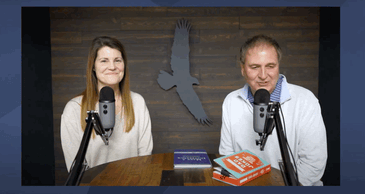
[00:00:08] Well, well, well, here we are in my favorite month of the year and turning the corner toward the most scary time of the year. We're in October, Melissa. It's fall. It is fall. And it's a super exciting time for lots of flavors and lots of fun and football. Are you a pumpkin spice girl? Do you like pumpkin spice?
[00:00:34] I do. I do. I even like pumpkin pie. You know, I really do. And there is something about those smells, those scents that just take you into fall. It's just part of it. It does. I'm a minority because I don't I'm not a pumpkin spice guy. I don't I don't need any of that. I know kind of what I like it. My favorite Starbucks location. But I don't but but I don't mind it.
[00:00:59] I don't I'm glad for it. I want everybody to enjoy it. I just I'm just not it's not for me. Right. But I love the fall and I love October and I love that it's getting cooler. Oh, my goodness. It's amazing. And watching the games and hanging out. It's just does it get any better? It's fun. It is a lot of fun. And today in light of being October, we're going to be talking about fear. The monster called fear. Yes.
[00:01:26] Well, you know, it's interesting that this book Crossing the Line that I wrote has a chapter entitled The Monster Called Fear. So if anybody's interested, as we talk about it, you want to dig a little deeper crossing the line, you can Robin what on Amazon and yeah, Amazon. Go to our website, either one. Eagle Center for Leadership. It's a great book, Larry. You did such a fantastic job with that. And there's so much meat in it. There's so much that you can read, you can use. So great book.
[00:01:55] So let's talk about let's jump in. I got a question for you. I have a question. So as we're talking about and going to be talking about fear as a child growing up. Yeah. OK. What was something that you feared? Oh, my gosh. You know, this is the story is true. I was I was young and I was afraid at that point. I was an only child. My sister was not born yet.
[00:02:23] I was young. And so I was afraid that somebody would break into our house, small house, little bitty house. But they would get it and, you know, and they would decide what they were going to take by what our stuff was worth, which was not very much.
[00:02:39] But I didn't know that. So I took a black magic marker, a Sharpie, and I went through it and opened the drawers to the dresser and in my parents' bedroom and in my room and in wherever there were things. And I wrote one cent. I wrote one cent on like everything. And what were you thinking? It didn't go well.
[00:03:06] But I was trying to protect our home from the burglars. But I remember that story. You had a plan. I was scared. So I feel like, you know, I needed to do something because someone they broke in, they would be looking for things of value. And if everything said one cent, well, surely they wouldn't take it. Listen, you were an entrepreneur from the start. You had a plan. You were on it. What about you? What are you scared of?
[00:03:29] So I had a little fear as a kid that there were going to be alligators under my bed at night. And so that they would come out and bite my toes. Yeah. I don't know. Maybe too much Peter Pan. They could slide under your bed. I mean, they had the right, you know, the right size for that. Yeah. Did you ever wake up with your toes kind of tingling? You know, sometimes I would wake up and I'd move my toes just to make sure they were still okay. Nobody. Yeah.
[00:03:59] Yeah. Well, here's an interesting piece about fear, too. So I want you to think about something that you've seen that is, you know, an interest in fear, maybe. I have this piece that, and it's been in the news where I live. And I think about, you know, fear and skeletons and things like that. It's kind of a funny fear, skeletons.
[00:04:26] But on the way to school, taking my daughter, there is not just in October, not just in, you know, that time of year that people might have things out like that. But this stays there throughout the year. We're talking Christmas. We're talking spring. And it's a family that has an enormous skeleton rooster. What? In their front yard. Rooster? Yes. In their front yard. Wait, a skeleton of a rooster?
[00:04:54] It's a rooster in their front yard. And you've got me on that. I've never heard. You know, you just go by it and you go, hmm, that's interesting. Right? No. You go, hmm, why? It's like one question for these people, wherever you are. And it's year round. It's year round. Help me out. What's the purpose? The rooster's there year round. What about you? You got something? I don't know. I cannot beat the rooster skeleton story. That's really good. I mean, that's just really, really strange.
[00:05:23] Some people, I will say, and we talk about fear. We're going to talk today about what fear does to us because it's irrational and scary. But some people like that scary stuff. And listen, like I know somebody that's, you know, she loves this time of year and she loves Halloween. And she's in the room with us right now. I mean, she goes after it. And Robin, you love Halloween. You love that kind of, yeah, she loves this time of year. Decorates. And, you know, I've never, I've never done that really. But, but I see the people that do.
[00:05:53] And I, you know, I respect it. She might make videos like ghost videos. Ghost videos. She did that. She, we had ghosts in our, in our office. Robin made a video of the ghost wandering around in our office. So, you know, props to that. That's fun. I can kind of connect with that. I understand it. I don't understand the rooster. I'm sorry. Back to the rooster. I don't get it. That is amazing. Yeah. What about some phobias? What are some interesting phobias? Okay. What are some interesting phobias?
[00:06:17] So, so there are some, there are some ridiculous, I'm just going to say phobias. One is, uh, it, it, it's pronounced Anna T day phobia, Anna T day phobia. You know what that is? I think, I think I do. I think I do. Yeah. Well, that is the phobia, not, not the phobia of ducks. No, it is not the phobia of ducks. Okay. You may have thought it was, but no.
[00:06:46] Anna T day phobia is the fear of a duck watching you from somewhere. So like you could be anywhere and downtown in your car and have this fear that somewhere a duck is watching you. A little duck. That's an interesting one. So I have another one. All right. Get it. Here we go. I have one. Let me see if I can pronounce it. An Iraqi beauty row. Phobia.
[00:07:16] Sounds like you got it. Okay. What do you think that is? You know, I think that could be a fear of a beauty row, you know, I don't know whatever a beauty row is. Yeah. Yeah. That's not it. It's a fear of peanut butter sticking to the top of your, the roof of your mouth. That does happen. And there's a fear for that. For that. A fear for that. Yeah. What about, do you, do you have one like for, um, a fear of fear? Do you have that one? Phobia. Phobia.
[00:07:48] Phobo. Excuse me. Phobo. Phobia. Phobophobia. Phobophobia. Phobophobia. Phobia. All right. Well, the truth is that on a more serious note, fear affects us and fear affects our relationships and fear affects our lives. And I've walked with people for years. You have as well, who have been controlled by fear and it's, it really is damaging. It's heartbreaking because you see what could be and what is not because of the fear and it truly polarizes and entraps people. Yeah. Yeah, it does.
[00:08:18] And so today we want to talk about fear, but we don't, we don't want to talk about, you know, there, there's a healthy fear. There's a healthy fear of things, but we want to talk about when does it kind of cross that line? And a lot of times it crosses that line and we're not aware of it. You know, we're, we're, it's tipped into the zone where it may be impacting your decisions or it's impacting your relationships, like you were saying. And it's gone to that place where, you know, some attention to that so that you can decide
[00:08:48] what you want to do with that, how you want to respond is important. Yeah, I totally agree. What starts, you know, we may say, okay, this is just, I'm protecting myself. So what starts as self-protection ends up as disconnection and it disconnects us from those we love, those we care about. It, it, and this is going to sound weird. It also disconnects us from our own self because we tell ourselves these irrational stories based on fear that causes us not to be who we really are, not to be who we really want to be.
[00:09:17] We don't trust ourself. Our, our, all of a sudden we get this irrational thinking and all of a sudden fear is controlling us. Now there, there are, you said it a minute ago and it's so true. Some fear is good. It just makes common sense. You know, you know, fear is what keeps us safe from walking out into the road. So, you know, it's stop and look and, you know, be fearful of things we ought to be fearful of in the context of what they, you need to be afraid of. But the problem comes when you take it out of context, you become irrational.
[00:09:47] You tell yourself irrational stories. You believe irrational stories and then you become irrational and man, you, you, you punish yourself and you punish those that you love and it can be devastating. Hmm. So let's talk about some stats around that because those are great points I want us to get to. Here's a stat. Seven in 10 people worldwide say they are unwilling or hesitant to trust someone who has different values or different backgrounds, social views. They, they're different. All right. Here's the thing. This is Larry's opinion.
[00:10:16] So let me go ahead and put that disclaimer out there. I'm representing my own opinion only here, but I believe that, that stat right there is what drives our political system of the day. I think the parties are polarized. I think if they can cause us to mistrust, uh, I just saw a clip just, just recently, um, where, you know, one party politician was calling the other party, all criminals and the other party, you know, said the same thing.
[00:10:43] And I think they capitalize on our fear of difference on our fear of cultural value difference, our diversity difference. I think both sides do this. And they say, if you're not like us, you can't trust them because they're different. And it's, I believe it's been the, the, um, preface for wars. I think it's been, I think it's been the determinant of, of crucial decisions that have hurt, uh, thousands, maybe even millions of people.
[00:11:09] It's that, um, I can't, if you're not like me, I can't trust you. If you don't think like me, look like me and walk like me, it's devastating. Fear just drops. It can, it can really drive us. Okay. I'll get up on my soapbox. I'm out. Great example there. So here is, of course, the number one fear and probably everyone can guess what this here is, and it's the fear of public speaking. Yeah. And actually people fear that more than dying. It blows my mind. Interesting fact.
[00:11:37] As a public speaker, I've been speaking in public for years. It, I do get it. I mean, the stress is certainly there, you know, like, you know, a fear. I have, you know, you, you fear of going on stage with your zipper being down, you know, or, you know, your shirt coming out of your zipper or something crazy, but you just kind of, I think, I think for me, it's about not taking myself so seriously and knowing that I'm human and, you know, but, but there, but there are, there's something to this.
[00:12:05] There are people who had, this is bizarre. They have a greater fear of speaking in public than they do. I'm glad that's, they do die. I'm glad there's no one in this room. Mm-hmm. No one at all. So fear can also, here's another data point. Fear can also increase while the actual danger actually decreases. Yeah. It's perception. It's, hey, crime rate is up. Crime, but the stat said that, you know what? People fear, we're more fearful for crime as crime rate was dropping. Why is that?
[00:12:34] Because the media promotes and propagates a skewed view of what's going on. So we have more knowledge, more data. Is that a good thing? I don't know, because now we have more knowledge and more data and it looks like we have more crime. We don't, we have less crime, but it, but, but, but it facilitates fear. So people are once again, irrationally fearful. Fear can breed more fear. It could really feed it. So let's talk about some real life examples of how we react based on fear.
[00:13:04] So here's, here are just some, some situations just to kind of get us, get us in the mode. We might avoid difficult conversations because of fear. We might ignore new learning opportunities because to learn can be difficult. And so that may, may cause us to be fearful. We might fear. And so we over protect our children. We might fear and try to control outcomes. We want it to be a certain way.
[00:13:32] Fear might drive us to hide mistakes because we, we mess up or we didn't make the right decision. And so it, it can, can push us to, to, you know, kind of hide from that. We might assume the worst fear can drive us to make up stories, to create storylines because we, we will assume the worst about a situation. And then we begin to believe that storyline because it begins to make sense for us. It begins to become real for us.
[00:14:01] People pleasing, leaving before being left. So before, you know, a situation, you know, gets to a, um, a disconnect, someone might start leaving that relationship or that situation because they, they don't want to, to be left in, in that situation. Using anger as a protection is driven by fear, keeping secrets, refusing to apologize, resisting change.
[00:14:31] So this is real life. These are real life situations, dynamics that the thing that might be underneath it, the feeling that might be underneath it, the thought process is fear. Yeah. And what I think happens here in, in all of these scenarios and these great examples that you gave is that fear drives us to fight or flight modality. It is, you've got either withdraw and protect yourself, you know, either withdraw, avoid or,
[00:14:59] or, or run the other way or, you know, put up walls when you should have boundaries and, and boundaries are good, walls are bad, or it causes us to be overly aggressive, overly concerned. We have to overreact out of fear. So I think fear, I think fear drives us to that all or none, uh, um, you know, fight or flight mentality, but we have some good news. Good news is we have a recipe that will help us to overcome some of this fear because the
[00:15:26] secret to the sauce is having, um, some people call it a bit of self-confidence. I'll call it self-trust, trusting in yourself, trust, having confidence in yourself, not that you're perfect by any means, but trusting in yourself that you can make good decisions that you can, you can, you, that you're, uh, capable of doing things that maybe fear would tell you in your head, you're not. So how do we get there? How do we get to this? I think the, I think the secret antidote is self-trust.
[00:15:56] So let's, let's talk about that a minute. How do you get to self-trust? All right. Think about in this way. And once again, I'll refer back in our book. If you, if you get to that chapter, you'll see this. Okay. You can't really see it right now, but think about, I call it a triangle, a trust triangle. And if you think about a triangle, the very base of that triangle, many people would say, well, that's where trust is. It all begins with, well, no, you can't, you can't have a foundation of trust. It has to be built. It has to be, it takes time to build that self-trust. So you can't just say, okay, I'm going to stop being afraid.
[00:16:26] Okay. No, no, no, no. There's a process. I love how you've broken this down into a thought process. There you go. You know, this isn't based on what we're about to talk about. It's not based on a feeling. Fear is obviously a feeling, but your, your, your recipe here is a thought process to redirect what you're thinking, to call on other pieces so that you can reflect on that.
[00:16:53] And you can figure out how to step out of fear instead of staying kind of locked in fear. So this, this first one, you talked about respect. So talk to us about that. It's not, it's not first. It's not just respect for others. It's respect for yourself. You got to respect. Yeah. And that's a choice. God, you, I don't feel, it's not a feeling. Respect is not a feeling. I don't feel respect. No, no, no, no. It's a choice. I'm going to choose to respect myself emotionally.
[00:17:20] I'm going to give myself boundaries, not walls, but I'm going to also give myself a gate that I can open emotionally to let some people in and appropriate. I'm going to choose to learn to regulate those emotions. I'm going to choose to, to, to learn to respect myself physically. I'm going to choose to give my, if I need space, if I need to take a walk, if I need to, to have some down, I'm going to give myself permission. I can't respect you any more than I respect myself.
[00:17:48] So it's about learning to set those good boundaries for my life, choosing to understand and learn what respecting yourself. Then I can respect others. Then it's about respecting others' boundaries, others' emotion, others. I can show you respect once I respect myself. Otherwise I'm manipulating you or I'm fearful of you or I'm trying to control you. So no, no, no. But if I have self-respect, then I can offer, and that's the first step.
[00:18:14] That's the bottom rung of working toward self-cust. So you're talking about respecting yourself first. Yes. You were referring to yourself first. You know, I think there are a lot of times people, people, they may respect others first. They may be respecting and wanting to respect others first without respecting themselves. And so they might lose themselves in other people. That's exactly right.
[00:18:40] And what that is, losing your identity or trying to find your identity in someone else, because then you think, well, now I have to meet their needs or I have to win their approval or I have to get their affirmation. All are in and of themselves, not bad things, but when they drive respect, when we drive our identity for ourselves, then it becomes very toxic and the relationship can't flourish. I can only meet your needs fully when I can respect myself and choose to meet your needs, not try to meet your needs because I need your approval of me.
[00:19:09] You know, and I think a lot of times that can get so confusing. You know, if I respect myself, then, you know, I'm all about myself. If I'm respecting others, I am, you know, getting worn out and exhausted because I'm always trying to meet others' needs and making some little shifts to be able to do both. Know where you fall. Do you fall on needing to respect yourself more, a little more? Do you need to fall on needing to respect others a little more?
[00:19:39] Trying to figure out where you are in this thought process and this recipe. Yeah, you brought up a great point. It's not arrogance. It's not narcissism. No, no, no. It's about learning to respect myself so that I can respect others and so that I can go to that second rung on the ladder. Because once I truly, so why am I respecting myself? Is it just because I'm arrogant? I only care about me? No, no, no. It's because I'm respecting myself so that I can have it. I'm working my way to self-trust.
[00:20:06] I'm respecting myself so that I can connect, which is that next rung on our ladder, on our triangle, I should say. It's that respect allows me now to connect. Now I can connect with you because I choose to. I can do things. I'm self-aware. But now I can become so that I know I respect myself. I respect those feelings. I'm not going to let them drive me. Now I can be aware using what we call EQ to begin to emotional intelligence, to begin
[00:20:36] to connect with others. I can connect with that other person because I respect myself. I'm not doing it out of any other motivation that I'm choosing to connect. So connection is being aware of your own feelings, using that EQ and making sure that when we do that, we're not carrying, helps us. When I'm self-aware, that means I'm not carrying, we call it emotional trash into the relationship.
[00:20:59] I can go over here and empty my trash can emotionally and I can do that so that I can continue to connect with you so that I'm not bringing mess. Yeah. And the respect leads to that connection because in connecting, if I'm not dealing with my own emotions and processing that, then I'm going to kind of spider web in my relationships. That means one emotion is going to be linked to another emotion that's going to get linked
[00:21:28] to another emotion. And all those emotions are not going to be good necessarily. It's going to keep me from connecting with others because my trash can, as you mentioned, is going to be full. And so to really be able to connect with others, we've got to do some of that work on the front end, right? Of respecting ourselves, getting ourselves in the mode to be able to connect so that we can overcome this fear. It's really helped me, Melissa, when you think about a trash can, you were talking about the spider webs and you think about all that.
[00:21:58] And when we have a trash can and we keep putting stuff in it and we can, it gets full and we just push it down and get something else gets in there and we push it down. And we think about that. The more we push down and the more we put in, there's not long before it starts to smell. And those smells are our behavior, our attitudes, our emotions that are not appropriate, our, you know, our feelings, all of those things. And if I can empty that out and respect myself and get ahold of that and become self-aware
[00:22:24] and work on my own regulation and work on who, if I can do all that, empty that trash can, don't let the past drive or dictate my future. If I can get there, then I'm ready to connect with you. Then I'm ready to connect with people that I love and care about. My children are those that I work with in every situation, whether it's at home or work, your spouse, your children, or your work. It doesn't matter. This process is helpful because it helps you to, to deal with some of the irrational thought
[00:22:54] processing or fears that have been driving you. So it's respect yourself so you can respect others. Begin to be self-aware and use EQ so that you can begin to connect with others, knowing who they are, knowing who you are. You're emptying that trash can. So that then what does that do? That opens the door for that third level, which is authenticity. What does that have to do with anything? Well, that means now that I'm, I'm respecting myself. So I'm not trying to manipulate or not driven by fear.
[00:23:21] I'm now beginning to understand what real self-awareness is and connection. Now I can be myself. Now I can begin to have who I am and who I'm not. And there are some non-negotiables, you know, in a relationship with people based on whether they're professional or, or, or personal or whatever, estranged or extended family. There are non-negotiables, but now I'm able to create those non-negotiables in a healthy way so that I can have the appropriate relationship with that person that I need to have.
[00:23:48] So, and then it also means now I'm free because I'm respecting myself. I'm self-aware and connecting. Now I'm free to own my mistakes when I make, when I mess up, Hey, it's on me. Let me raise my hand. That wasn't me. And it's not devastating. It's not, it's that I own it. And I move forward and you can tell how healthy someone is really by how likely they are to own their mistake. You know, and, and as you're talking, I'm thinking authenticity, you know, what does that really look like?
[00:24:18] What does that look like? You know, authenticity is, it's a sweet spot. You know, it's kind of a, it's where you have appropriate boundaries and, and no one ever gets that perfect. It's, it's not that you arrive at this place. It's a constant, you know, trying and giving and trying to figure it out, you know, but authenticity is not isolation. Authenticity is not, I have to have it all together. Authenticity is not oversharing.
[00:24:45] Authenticity is, is not trying to overconnect. Authenticity, you know, really being able to understand who you are, being able to operate in a humility and owning things, but also stepping out at times, being able to step out when you need to be able to step into something that you need to. Well, that leads us to the, to the very next rung as we get up towards self-trust. When you're authentic, it really allows you to have healthy conflict.
[00:25:15] It allows you to speak into those hard conversations without personalizing. I need to have this hard conversation with someone. I'm not going to emote. I'm not going to allow my emotions to drive my behavior now because I respect myself. I respect them. I'm connecting. I'm self-aware. I'm authentic. I'm being real. I'm not, and what, but I need to be heard. So now I'm building that confidence as I go up this triangle to I'm being heard.
[00:25:42] And, and being heard means stepping up to say what we need to say, and then expecting others to listen and hear us and us hearing them. Two street. You call it ping pong. It's about ping pong is about me being heard and then you being heard than me being heard than you back and forth. And I think that's, that's, that's a brilliant way to put it. And that's what, when we can have healthy, every relationship should have conflict every at some level.
[00:26:10] If you just agree with a hundred percent of someone and everything they say and everything they are and everything they like and everything they don't, that, that is a, that's a boring relationship first. And it's, it's irrational. It's not, it's not real. It's not authentic. But when you can have that healthy conflict and then you can feel like I'm being heard. Now, sometimes, sometimes in these situations, remember you're only responsible for your own behavior. So you may try this and the person still may not hear you.
[00:26:38] And that is not for us to own. That is for us to draw the boundaries around if that happens. And that's the distinction. And that's an important distinction. So as we finish up today, we've, we've talked a lot of, we've gone really deep, really quick. And so we're going to come up for air on this, but here's the shift. As we talk about little shifts that make a big difference is to shift from fear to self-trust and do that one little shift at a time, just taking one little step.
[00:27:05] And one of these four areas that we've talked about today, I think will make a big, a big difference. I hope so. And let me tell you what, because you're going to need it. Halloween is here. Ghosts and goblins and ghouls are all here, Melissa. And so you've got to get ready. We don't know. You may get roosters with skeletons. Gosh, I don't know what might happen here at Halloween. I do know. I believe there's a joke coming. I do know. It's time for that joke. And it's a bad joke.
[00:27:34] People ask for, they want it, they need it. And we want to be, we want to be givers, Melissa. We want to give, give our, give our audience what they want. And I know you and Robin wait for this. It kind of is what you get up on the days that we record and you're just, yeah, you know, you can be honest. You got excited. First thing this morning, not about, you know, getting the kids ready for school and all that's going on you, but it was about, Hey, I get to hear a dad joke today. So I, um, I'm going to, and it's our lucky day.
[00:28:02] It is your lucky day because I'm going to, today is kind of a, it's kind of a scary one. Yeah. Okay. This is kind of scary. Are you ready? All right. Speaking, you know, fear and things that you're scared of. What do you get when you cross a snowman with a vampire? What do you get when you cross a snowman with a vampire? Frostbite. Oh, that's a good one. That is a good one.
[00:28:32] There you go. Really good job today. Really good job today. All right. Hey, thank you guys for hanging out with us today. I hope you found some things in this pod that helped you and helped your relationships. It's an honor for us to, to be here and to walk this journey with you. We certainly appreciate you. And thank you for making those little shifts that make a big difference in your life. You guys take care. We'll see you next time. Little shifts that make a big difference. Real shifts.
[00:29:02] Little shifts that make a big difference. Thank you for tuning into the relationships podcast with Dr. Larry Little and Melissa Hamburg-Jackson. We hope today's conversation inspired you to make meaningful shifts in your personal and professional relationships. We want to hear from you. If you have a question for the author, Dr. Larry Little about personalities or relationships, send in your questions to the link in the show notes.
[00:29:30] Stay connected with us online at Eagle Center for Leadership dot com and follow us at Eagle Center for Leadership on Facebook, Instagram and LinkedIn for more insights, resources and updates. Don't forget to subscribe to the relationships podcast so you never miss an episode. And if you found value in today's discussion, we'd love for you to leave us a review. You can also watch episodes on YouTube through the Eagle Center for Leadership channel. Until next time, keep choosing to make the little shifts that make a big difference.