
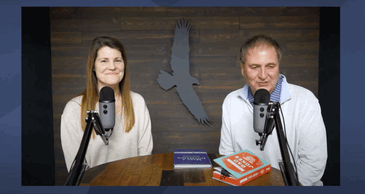
[00:00:09] Hey everybody this is Larry Little. And I'm Melissa Jackson. And you're listening to Crossing
[00:00:13] the Line, a podcast where we talk about relationships and leadership and we've got a great topic
[00:00:17] we want to bring you today, Melissa. Yes, and it is about words, Larry, and the power
[00:00:23] of words. And we have to start off though and step back and talk about what's going
[00:00:27] on. It's August and if you have children or grandchildren or friends that have children,
[00:00:33] it is school time again. We are back in the swing of the fall.
[00:00:39] We are at it. I mean, the rest is over if you had rest for the summer and then we're
[00:00:46] about to hit the road to the fall. Let me tell you why I'm excited. I know you have
[00:00:52] a 12 year old and so you guys were all into school and getting ready and she's in the
[00:00:57] band and that's awesome and all of those things. For me, my children are grown, right?
[00:01:04] So I am looking forward. I don't know if you know this or not, right? But this fall, the
[00:01:10] SEC is having a football season like none other. I mean it is a brand new, I mean
[00:01:17] season with the divisions are gone. We've got two new teams in the conference. I'm
[00:01:26] so excited to see. Oh, the playoffs have been expanded. Both of you, Robin our director
[00:01:33] producer and Melissa both of these ladies are looking at me like I've lost my mind.
[00:01:37] But I think it's going to be fun. It's going to be a fun. It's going to be fun. Yeah.
[00:01:42] Well, you know, we're here we go. Yeah, let's do it. I hear the excitement. I hear it.
[00:01:50] But you know what? It is school and you guys both have children and you guys are ready
[00:01:54] and I'm excited about the school. The school year. And football, and football.
[00:01:59] The fall brings a lot of fun and we're ready to roll. So let's talk about the
[00:02:04] power of words. So words really influence relationships. They influence how you
[00:02:10] feel about yourself, how others feel about themselves. You know, the ability
[00:02:16] to speak powerful words can change somebody's trajectory. It can help them
[00:02:22] grow. It can cause them to feel, you know, depleted. So there's a lot of power in
[00:02:28] what comes out of our mouth. There really isn't. And when I saw that we were
[00:02:32] talking about this today, I thought, you know, this is our sweet spot. We teach
[00:02:36] this. We live it. We see it. But more importantly, it's so relevant today
[00:02:41] because we live in a world that's saturated with words like never before.
[00:02:47] I mean, think about the social media. Think about, you know, eggs or Twitter
[00:02:50] or, you know, all that Instagram face. All of that. All that is, you know, those
[00:02:54] are, those are words. Those are words people are saying and they're so
[00:02:58] powerful. They impact elections. They have, they've taken businesses down.
[00:03:03] They've given businesses notoriety. Words are incredibly influential and
[00:03:10] they're incredibly powerful. Everybody wants to have a voice. And, you
[00:03:14] know, they want to be heard. And so, you know, we really have to break it
[00:03:19] down and make sure that the words that we're using, the conversations that
[00:03:23] we're having, that, you know, they're helpful. They inspire. They encourage.
[00:03:30] They bring about growth and development. They give opportunity. Something
[00:03:35] for us to think about as leaders and try to lead at home, lead at work.
[00:03:40] Yeah, it really isn't. Whether it's positive or negative, words are
[00:03:45] powerful and they can, they can be either way. But it's not just about how
[00:03:50] words make us feel. There's scientific evidence out that, you know, words
[00:03:56] impact our brains. Neurologically, a study was done by the Cascio group
[00:03:59] that said, you know, when someone has positive affirmation given to them
[00:04:04] over and over that positive, that affirming, that positive mindset,
[00:04:10] literally the pathways and the prefrontal cortex of the brain expand. Now,
[00:04:16] you can take that in reverse and say when there are negative, critical,
[00:04:21] demeaning types of words in an environment that's negative, those
[00:04:26] pathways close. So it actually closes your capacity to think. And so it,
[00:04:32] how what we say and how we say it very little, literally, physically
[00:04:38] affects our minds. So there's science behind this that really can help us
[00:04:42] understand why it's important and why we need to give some attention to it.
[00:04:47] You know, also in diseases and cancer and illnesses and, you know, we find
[00:04:53] research there also that helps us understand how an environment can be
[00:04:57] more conducive to somebody's healing, that it can help them in the process.
[00:05:04] Yeah, I've seen it for years, a cancer patient or someone with a disease
[00:05:07] that's very difficult, maybe even terminal. But they're so positive and they fight
[00:05:13] so hard. And the process of that, if it doesn't bring healing, even the
[00:05:19] process of walking through that disease is different from someone that is
[00:05:23] surrounded by loving supporting family, loving supporting relationship.
[00:05:29] That whole process is different than someone who becomes a victim,
[00:05:33] who gives in and who literally gives up. It impacts the people that are watching,
[00:05:39] you know, watching that person go through that. So let's talk about
[00:05:42] the power that it does give and talk about how do we help ourselves be able to
[00:05:50] learn something from this? So, you know, words, if we talk about three things that they do,
[00:05:56] words can set a tone. It can set an environment. Yeah, it does. You know, that's going to affect
[00:06:04] your body physically. It's going to affect your mind. Think about a home though where
[00:06:08] there's love and there's kindness and there's goodness and there's acceptance and there's
[00:06:13] there's still struggle. But that scenario while we walk through the tone is we love each other,
[00:06:20] we're there for each other. The tone is our words are going to be kind. I know that
[00:06:25] you have done some work around that even on kindness and and it was really inspirational
[00:06:29] to me to see what you did with just just saying, hey, we're going to have kindness.
[00:06:34] We're going to focus on kindness in our home. That was powerful to me to see that and I've
[00:06:39] thought about it often. And I think that tone we can have a tone of kindness in our
[00:06:44] business relationships in our home or we can have a tone of criticalness, negativity,
[00:06:51] sarcasm. I was at a meeting last night and I watched the leader
[00:06:55] set the tone for the meeting and he set it up for the people that were following him
[00:07:01] in conversation to, you know, have a positive slant. Let's talk about the positive things
[00:07:06] that are taking place. Let's let's talk about the impact that this has had on the group.
[00:07:11] And so I sat back as just observer and I watched how the tone got replicated
[00:07:18] and how it continued. There might have been an obstacle. There might have been a concern.
[00:07:24] But the tone was able to overall be replicated and it's important. You know, we can set the tone.
[00:07:33] Yeah, that's very important. I think it is. And in another word as you think about,
[00:07:37] what are they talking about tone? We're talking about the environment that you set
[00:07:40] for your relationships, whether it's a personal relationship or in your home or in
[00:07:44] your business and with your team. The tone is the environment really that you say.
[00:07:48] And by the way, you get to do that. You get to set that tone.
[00:07:51] That's a great point that you're making. You know, we need to be mindful
[00:07:54] because there are times where we don't have the energy or, you know, we're exhausted.
[00:07:59] You know, you've used your words up for the day. You know, you've used your middle capacity for
[00:08:05] the day. But, you know, you still have people in front of you, your family, your loved ones,
[00:08:12] those relationships that are key that, you know, you get the opportunity to figure out what
[00:08:17] you're going to do with that. So words also, they set a thought process. And so if they set a tone,
[00:08:24] then what is next is it starts enabling a thought process. It starts taking you down a pathway,
[00:08:30] so to speak, that sets up a thought that is going to be replicated a thought process.
[00:08:37] Yeah. Think about it like this. If you're someone who hikes and you enjoy nature,
[00:08:42] you go out and the thing you don't want to do is to go for your own trail. You want to find a path,
[00:08:48] you want to find a hiking trail because that hiking trail is going to lead somewhere that
[00:08:53] you want to go if it's up the mountain or to the end of the hike, into the trail, whatever.
[00:08:58] However, when you, so you want to stay on that trail and you, when you're having a thought
[00:09:04] process around words, those words define a trail and you keep walking down that trail.
[00:09:09] It's either a positive mindset, a tone of kindness, or it's a negative trail that leads you to criticism
[00:09:16] and negativity and depression and anxiety. You get to, you know, it's one trail or the other,
[00:09:21] but that thought, think of it as a thought process, much like a path, a path the way
[00:09:24] that you're walking. You're making a great point too because that can be fed. Yeah,
[00:09:30] that thought process can multiply when you feed it and it can open up other thoughts,
[00:09:37] critical thoughts or other feelings that, that lead to an overall theme if we're not careful.
[00:09:46] And we'll talk about it in a minute, but that has consequences. The further you walk down
[00:09:50] that pathway, the more consequences there are. Certainly you can turn it around and go the
[00:09:55] other way. Certainly you can, you know, take another path, but there's a lot of times that
[00:09:59] means you got to clean up some stuff. And you know, it, part of life, part of relationships
[00:10:04] is cleaning up. Absolutely. It's about being aware and taking ownership and trying to,
[00:10:10] to rectify the relationship because there are plenty of things that cause us to go off path.
[00:10:17] The third piece if we're talking about words and how impactful they are and how this builds on each
[00:10:22] other. So, you know, we're setting a tone, a thought process, well then it leads to behavior.
[00:10:27] Yeah, it really does. And that's what you just, you know, alluded to is that,
[00:10:32] that behavior means I've got to literally turn around and take another path. I've got to,
[00:10:37] to walk in a different way. That behavior is everything from body language. It's everything
[00:10:44] from, from the time that you spend with that person or the time you don't spend with others,
[00:10:49] how you set that relationship tone and thought process ultimately ends up in how you behave
[00:10:55] in that relationship toward that other person, toward that team, toward that family. It has
[00:11:02] direct implications on our behavior. I'll tell you from a personal experience, you know, I have to
[00:11:08] really, from a tone of thought process and a behavior, you know, Melissa at night,
[00:11:15] you know, I kind of, I'm not my best at night. You know what I'm saying? I just,
[00:11:20] what you said a minute kind of used my words up during the day. I enjoy, for those of you
[00:11:25] that understand our personality, I enjoy a little turtle time, which means just kind of some introverted,
[00:11:30] kickback, relax, renew. And a lot of times I don't get that because of the situations that are going
[00:11:35] on. And I have to really be intentional about the tone. I said when I can't have that and,
[00:11:41] and I'm expected to still engage, I'm expected to interact. I'm expected to create an environment,
[00:11:47] a thought process that says I'm going to walk down a path of kindness and engaging.
[00:11:53] I'm still going to talk and I'm still going to try my best to be coherent, which is a challenge.
[00:11:58] And that directly affects my behavior toward those in my family, toward those that I live with
[00:12:04] and those that I love. And in fact, my wife just told me this week, she said, you know,
[00:12:09] I like your lot better in the morning than I do in the evening.
[00:12:14] I guess. And I said, well, I like myself too better. And I'm glad we're recording this
[00:12:19] podcast in the morning. I love it. So, you know, the behavior piece, you know,
[00:12:26] it makes me think about the two story of growing up. I watched this couple behave with each other.
[00:12:37] I was able to have a front row seat in their life and just watch them. And,
[00:12:43] you know, from a personality standpoint, the wife was a monkey. The husband was a camel.
[00:12:50] And I watched the power that she had in the relationship of how she could help turn him,
[00:12:58] how she could help him when he began to kind of overthink things and how she had
[00:13:05] that leverage with the power of words and could pull him out and help him kind of
[00:13:12] get things in a different way. And their relationship impacted my life and they helped
[00:13:18] me see the importance of words with each other. And so, you know, we need to be challenged in
[00:13:25] this area. So let's talk about some things that we can do to be mindful of this. How can we help
[00:13:30] ourselves and help those that are listening? Yeah, I hope we have set up appropriately
[00:13:34] the importance of words. And I hope our listeners hear that. But then the question
[00:13:39] obviously becomes, okay, we get it. You know, it affects all these things. So how do we,
[00:13:43] what do we do now? What is the next step? And good news is anyone can change,
[00:13:50] anyone can take control of their words and ultimately their behavior. The first thing
[00:13:55] is to realize that you do have a choice. It's not, well, I'm just negatively,
[00:14:02] I'm a natural negative. It's no, no, no. Or I was just, I'm critical by nature. No, no,
[00:14:06] we get to choose. It may feel like we want just because I want to respond in a certain way,
[00:14:13] doesn't mean I have to respond. I think we forget that. I think we run so fast.
[00:14:19] Things keep us so busy. You know, we have so much in our fingertips and things occupy our space,
[00:14:27] our mental space that we just, we forget that we have a choice at Tom's.
[00:14:31] Yeah, we really do. And it's so that if we can keep that number one,
[00:14:34] understand, I get to choose now in order to choose, you've got to take a step back and be
[00:14:39] self aware and be aware of what's going on around you. You've got to take that step back to give
[00:14:43] yourself space to choose. So it might mean taking a beat, but remember, you get to choose your
[00:14:49] words. Now this is a problem. Melissa, I just want to chase one rabbit. I'll become right back
[00:14:54] because it's kind of a pet peeve of mine. This is the problem because people get on social
[00:14:58] media and they get on, you know, the X and whatever and whatever comes to them,
[00:15:03] whatever they're feeling, boy, they'll text it in and they'll excuse this language.
[00:15:08] They'll vomit those words out there and it hurts a lot of people. And they would never say some
[00:15:14] of those words if they were sitting in the room with that person. They would never do that.
[00:15:19] They respond so differently when you're looking at them. And so I think it's important in this
[00:15:25] social media age that we take responsibility for the words that we type as well as the
[00:15:30] words that we say. And so I think chalk, I'm back. Sorry. But I think that we get to choose.
[00:15:37] That's the first thing. Second thing is we got to remember just because we choose doesn't mean
[00:15:41] that we get it right. You said it a minute ago, we all go off path. We all go on different paths
[00:15:46] we shouldn't be on from time to time. We all blow it. So it takes practice. It takes
[00:15:51] practice. It means that we've got to put in the practice to give ourselves permission to go.
[00:15:57] I shouldn't have said that. Let me back that up. Let me reel that back in and let me try again.
[00:16:02] We all get do overs in this life and we all get do overs when it comes to trying to get better
[00:16:09] and try to live a life of kindness versus criticism. So I think it's important to give
[00:16:14] yourself permission to fail, to blow it because it takes practice. And we do need do
[00:16:19] ever. So we need to allow ourselves to do that. In a learning environment and if you
[00:16:24] look at how you learn, everybody learns differently. Right? They have different ways that they
[00:16:29] really can retain things. But there is a process to learning and a lot of times what happens is
[00:16:35] when we're trying to learn something, we may overcompensate. We may try so hard to do it
[00:16:44] that it's a little, you know, it's awkward and comfortable or we may not try as hard because
[00:16:49] we don't know if we're going to get it right. But there's like, there's a process to
[00:16:52] learning something and we need to allow ourselves an opportunity to figure out where we want to
[00:16:58] land and what do we want it to look like and allow ourselves to learn and understand how we're trying.
[00:17:04] So that self-awareness that you talked about that can help us really make it a choice.
[00:17:10] I think that's exactly right. And when we do that now for our for our task driven friends
[00:17:16] that are listening, right now you may be listening and you may say, okay, I'm going to choose
[00:17:20] and you know, I'm going to do this and I'm going to practice and I'm going to and then,
[00:17:24] you know, then I'll have it. Well, it just doesn't work quite that way. So the third thing is this,
[00:17:29] if we know we have a choice, you know, get a practice, we need to understand it takes work
[00:17:34] to change our lifestyle. This is not a task that you check off. This is a lifestyle. And
[00:17:40] here's why here's what's important. Give yourself permission to practice and fail,
[00:17:44] but then realize that creating a lifestyle means we have to be consistent. We have to work at
[00:17:49] it. It is hard. It is not easy. It is not soft. It is very difficult to change our pathway. But guess
[00:17:54] what? The more we do that, the more pathways we create, the more pathways we create, the more
[00:18:00] likely we are to walk on those new pathways, the more likely we are to walk on those new pathways.
[00:18:06] That means that we're creating a lifestyle. So that lifestyle is created so it's not,
[00:18:10] it's not instant gratification here. That's not what we're saying. What we're saying is
[00:18:14] be willing to put in the work to develop the pathways to change your lifestyle. So then you can
[00:18:20] become a person that says, I'm going to use my words to influence others in a positive way. I do
[00:18:26] need to give a disclaimer here. I'm not talking about being overly positive when it's inappropriate.
[00:18:32] Thank you. I'm not talking about pie in the sky mentality. I'm not saying that because we
[00:18:37] you know what sometimes to be clear and to create clarity is to be kind. And sometimes to be direct
[00:18:45] and to have those hard conversations is to be kind. It's the motivation with which we have
[00:18:52] those conversations. So we still, life is hard. I'm not saying it's not. I'm saying that we need
[00:18:58] to choose how we address those hard difficulties in life, those struggles, how we address the
[00:19:05] others around us. Sometimes it means having difficult conversation and saying we've got to,
[00:19:10] we've got to get to the point where we either agree to disagree or we resolve because we need to have
[00:19:15] this thing. You know, you will have conflict. I'm not saying avoid conflict. I'm saying do it with
[00:19:19] the right motivation. Do it with clearness. Do it with kindness. And when we do that,
[00:19:24] those pathways will continue to open and will become a different, literally a different person
[00:19:29] neurologically. And I've seen it over and over again, those people who get this,
[00:19:33] who understand it, who understand their choice, who understand that they're the need to practice.
[00:19:37] In fact, they understand it's a lifestyle. They become more powerful and influential
[00:19:41] because others trust them more because of how they're handling their words.
[00:19:46] Well, it sets you up to live in a different zone, just like you're talking about. And
[00:19:51] you give yourself some freedom when you fall and you fail because we're going to,
[00:19:56] you can recover and you can choose to respond differently and it impacts, it impacts your
[00:20:03] relationships. That's right. So as we wind up this podcast before we get to my favorite part,
[00:20:09] which is coming, I want us to do one thing. So, so we've talked about these affirmation,
[00:20:16] these words. So I want us to take a minute and you and I, let's give some affirmation
[00:20:22] to the person who really makes this podcast go. Let's, let's give some affirmation to the person
[00:20:27] who's never, never seen or heard her name is Robin and she is the one that puts all this
[00:20:33] equipment together. She's the one that gets our script. She's the one that was she just is
[00:20:37] the credible. She's incredible and behind the scenes. So I'm going to give you first shot
[00:20:41] to talk to Robin. She's sitting here. So you're speaking to her and let's,
[00:20:45] let's practice here what we've been talking about. Now we know a secret about Robin that
[00:20:50] makes it even more powerful. I hope and that is, we know her personality. We do. She is a very
[00:20:56] high camel and she's the camel of all camels. And so Robin does a quality job at managing
[00:21:06] all the details to make the content and the recording so powerful and I'm very appreciative.
[00:21:18] Yeah. I tell you this, Robin is one of the few people, she's brilliant. She's one of the smartest
[00:21:23] people on that. Incredibly brilliant but, but that can navigate a lot of things at one time and how
[00:21:30] she pulls all this together in an organized form that allows us to move forward in this and to
[00:21:35] speak into the lives of others. She's a godsend, an essential part of what we do here and an
[00:21:41] incredible leader, incredible teammate. So I think the joke today should be in the honor.
[00:21:48] She's loving it. Robin, this joke is in honor of Robin. Oh yeah. So we go to my favorite part
[00:21:54] in honor of Robin. This is the dad joke of the podcast. It's my favorite part of the podcast
[00:22:00] and so are you ready for the dad joke? Robin, are you ready? Thumbs up. All right here we go.
[00:22:21] Help, I'm falling and I can't get it up.
[00:22:26] It just gets better every time. Every time. Hey, thanks you guys for listening and for hanging in
[00:22:33] there with us and I hope I brought a smile to your face with my dad joke but more way,
[00:22:38] more importantly, I hope you gained some things today to help you and your relationships as
[00:22:43] you cross the line to make a difference in the lives of those you love, you live with
[00:22:47] and lead. We'll see you guys next time.