
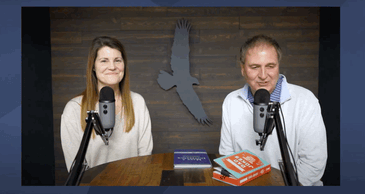
How do you navigate family relationships through the divisive waters of politics? My daughter, Ren, and I took on the topic in the latest episode of our Crossing the Line podcast. We strived to have an open, honest, and hopefully helpful conversation about politics. Ren tends to support one party, and I typically support the other. We shared how we deal with our differences without blowing up our relationship.
[00:00:08] Hey everybody, this is Larry Little and you're listening to Crossing the Line, a podcast where we talk about people and leadership and relationships.
[00:00:16] And today, Melissa is taking a break and we have a very special guest on the podcast. I'm pretty excited about it.
[00:00:25] And welcome Wren Little, my daughter.
[00:00:28] Yay!
[00:00:28] Yay, I'm so glad you're here. Wren is COO of an organization called Mo News, is that right?
[00:00:36] And it is a wonderful podcast. In fact, I recommend it. So if you need a really good news podcast, a daily news podcast, plus other stuff, I have no idea what, but she knows.
[00:00:47] But man, I truly recommend it. Mo does a great job and congratulations on your new position in his organization.
[00:00:56] Thank you. I'm very excited about it. And I'm also very excited to be here with you today. A little bit of deja vu.
[00:01:02] A little bit of deja vu. So we did this podcast four years ago around the political season and I asked Wren if she would come back and let's do it again.
[00:01:15] Because we got a lot of good feedback. I think it helps some people is what I think. And if we can do that again, you've changed, I've changed.
[00:01:24] We're a little older.
[00:01:25] A little older. A little older.
[00:01:28] Not four years older.
[00:01:30] Absolutely not.
[00:01:31] But at least four years wiser.
[00:01:32] You know, people wonder how I can have a daughter your age and, you know, I was a child groom.
[00:01:39] You were just a baby yourself, really.
[00:01:41] Right. But we want to take this opportunity just to be honest and talk with each other and see if we can share some things from our lives.
[00:01:49] Because we have a great relationship and that's grown through the years.
[00:01:56] I feel very blessed about that.
[00:01:58] Very fortunate that we can have the relationship that we have.
[00:02:01] But if we can help some folks.
[00:02:03] And folks need help.
[00:02:04] We're going to talk politics today.
[00:02:05] And here, just something that kind of blew my mind.
[00:02:10] A study came out recently saying that over 100 million families, over 100 million, are separated over political views.
[00:02:20] That's amazing to me.
[00:02:21] That's just an amazing stat.
[00:02:22] And another survey said that while families disagree and are separate, they really don't know what to do.
[00:02:28] They don't know what to do to repair these relationships.
[00:02:31] So I thought, hey, let's just jump in there and see if we can help.
[00:02:34] Yeah. And, you know, 100 million, that's, I'm really bad at math, but not quite a third of Americans are feeling like they're separated from their families over politics.
[00:02:44] And, you know, I think it's important for us to say, I don't think we have all the answers here.
[00:02:49] I don't, these are conversations I still struggle with.
[00:02:52] I have been struggling with for the last, I don't know, 15 years of my life, more or less.
[00:02:59] But I do think that the thing we can do is just kind of have these conversations openly and let people know that if you're having them and you're struggling with them, that's okay.
[00:03:09] It doesn't mean your relationship is falling apart.
[00:03:11] It doesn't mean there's anything wrong with you or with the person you're arguing with.
[00:03:14] It just means we're all human and that the world is particularly messy right now.
[00:03:18] Now, I think especially when it comes to politics, it feels heightened.
[00:03:21] We're in an election season.
[00:03:22] This is our fun little election year tradition.
[00:03:24] Yeah, we are.
[00:03:26] Hey, this is a tradition.
[00:03:27] I like it.
[00:03:27] Yeah.
[00:03:28] And full disclosure, generally speaking, you're on one side of the political culture.
[00:03:34] I'm on the other side of the political landscape, I guess I should say.
[00:03:37] Right?
[00:03:38] I mean, should we just leave it up to our listeners and viewers to figure out who's on what side?
[00:03:42] Well, you're right.
[00:03:42] Yeah, I think it's not a super secret where we kind of align.
[00:03:50] But I will say also both of us, there was some other statistic in here.
[00:03:54] I don't know if we wanted to mention it.
[00:03:56] Both of us do, I think, fall more in that moderate category too.
[00:03:59] Yeah.
[00:04:00] And that stat said that group is growing.
[00:04:02] Yeah, exactly.
[00:04:03] And I think it is.
[00:04:04] I think that people are tired of feeling so polarized.
[00:04:08] They're tired of feeling so labeled.
[00:04:10] They're tired of people coming up to them and being like, well, if you voted this way, then
[00:04:13] you must automatically believe this, this, this, this, and this.
[00:04:15] Because I think we've started to realize there's a lot more nuance to being a human than who
[00:04:19] you voted for.
[00:04:20] And frankly, there's a lot more important things in life about your identity as a human than
[00:04:24] who you voted for.
[00:04:26] And at the same time, it's important.
[00:04:28] Like, it's important stuff that we're talking about.
[00:04:30] Politics, they do shape our lives in a lot of ways and they shape our country.
[00:04:35] And I'm, you know, I'm glad we're here today so I can convince you to vote for my candidate
[00:04:40] because democracy is at risk.
[00:04:41] Have this conversation.
[00:04:42] And the country will crumble if you don't see my way and see it now.
[00:04:45] Sound the alarm.
[00:04:46] Wee-wee-wee.
[00:04:47] That's the democracy alarm.
[00:04:49] I love it.
[00:04:49] And we're going to get into some of that, I hope, in just a bit as we talk about, you
[00:04:53] know, who we are and what defines us and what doesn't.
[00:04:57] So as we think about this thing, we think about politics.
[00:05:01] Where do we start with this, Rand?
[00:05:03] What do we jump in?
[00:05:05] Yeah.
[00:05:05] So I want to jump in just being really candid about where I'm at with this whole idea of
[00:05:10] how do we have conversations with people we love and our families about politics.
[00:05:15] And I think, especially when I was going back and listening to the podcast we did four
[00:05:19] years ago, I, at that point in my life, four years ago me, was at a point of trying to
[00:05:25] lean back out from them because it had been so contentious and I had hurt some relationships
[00:05:29] leading up to that.
[00:05:30] And I was at a point of like, okay, I need to, I need to lean out from this and I need
[00:05:34] to figure out how do I just kind of avoid it?
[00:05:37] Do you remember when we were younger and we would watch movies and anytime there was
[00:05:41] a scene where the dog died or the dog might die or the dog might even like pull a toenail?
[00:05:45] Do you remember what I did?
[00:05:46] Oh yeah.
[00:05:46] You put your, what, your hands or your blanket or your pillow, anything around you over
[00:05:52] your eyes immediately.
[00:05:52] Yeah.
[00:05:53] I checked out.
[00:05:53] I was like, this is hard.
[00:05:54] I cannot handle it.
[00:05:56] I'm out of here.
[00:05:57] I don't want to, I don't want to participate or process it.
[00:05:59] I still do that today.
[00:06:01] But, and that's sort of, I think where I was at with these kinds of conversations is like,
[00:06:05] this is hard.
[00:06:06] I don't want to deal with it.
[00:06:07] I don't know how to process it.
[00:06:08] The best thing for me to do, if you can't say anything nice, don't say anything at all.
[00:06:13] The problem with that is that if you don't say anything at all, you don't say anything.
[00:06:18] Right.
[00:06:18] So I think the place I'm coming from now, what I'm grappling with in this moment, and I want
[00:06:22] to hear kind of where you are is this tension between loving people and valuing relationships,
[00:06:30] which is something that very much was instilled in me by you and my mom growing up and prioritizing
[00:06:36] relationships over anything else, which I very much believe and is very much a core part
[00:06:39] of who I am.
[00:06:40] And as I continue to, you know, get older and come into my own beliefs and try to be
[00:06:45] a confident 30 something year old woman, figuring out how do I know what my convictions
[00:06:50] are and stand to them and feel like I can confidently be who I am and stand in that and kind of present
[00:06:56] that to the world.
[00:06:57] And there's a little bit of tension there sometimes for me anyways, where when I feel like who I
[00:07:01] am and the things I believe in are coming into conflict with prioritizing these relationships.
[00:07:07] And so that's where I've been leaning out and I want to find a way.
[00:07:10] And I think this is something that you've been helping me do my whole life, really.
[00:07:15] But I want to find a way to have these conversations, be who I am, know what I know and be confident
[00:07:22] in that and prioritize the humans.
[00:07:25] Yeah, I think that's a great mindset.
[00:07:28] And, you know, I think going back just to take a dad moment, you know, one of the things
[00:07:32] that I really wanted for you and your mom really wanted for you, we wanted you to be
[00:07:37] a strong, independent, you know, woman.
[00:07:40] I think we and I think we've accomplished that.
[00:07:42] How's that working out for you?
[00:07:44] Well, no, I actually love it.
[00:07:46] I just and I may be a little weird on it, but I just I love that you think for yourself.
[00:07:51] I love that you come to your own your critical thinker.
[00:07:54] You come to your own conclusion.
[00:07:55] And we that's the way we raise you.
[00:07:56] Right.
[00:07:57] So now we're paying the consequences that you don't agree with us on on some things
[00:08:02] that we might value or that we might think.
[00:08:04] And you have your own opinions and things that you value.
[00:08:07] But at the core, that is our relationship.
[00:08:09] And the core of that is that relationship continues to be strong.
[00:08:13] That's what we kind of want to talk about, because I think today it's it's that tension
[00:08:18] that people struggle with.
[00:08:19] How do I allow someone I love to be who they are and vehemently disagree with them on some
[00:08:25] on some issues?
[00:08:26] So I kind of want to go there and let's talk about that in our lives.
[00:08:30] And let's talk about how we how we've done that, because part of being an independent,
[00:08:36] strong woman is creating your own opinions in politics, political views.
[00:08:40] Right.
[00:08:41] Yeah, exactly.
[00:08:41] And, you know, it's not like we're disagreeing on where to eat for dinner.
[00:08:45] Right.
[00:08:45] These are things that feel really impactful and they feel really important.
[00:08:50] And it feels really core to who I am and what I believe sometimes these political
[00:08:54] beliefs.
[00:08:56] And to say all that, I mean, I do think some of that has shifted for me as over the last
[00:09:01] four years.
[00:09:01] So we can talk about that a little.
[00:09:03] But I'm curious before we jump into like actually how we're having these conversations.
[00:09:07] How have you changed over the last four years as you were listening back?
[00:09:10] Yeah.
[00:09:11] We did.
[00:09:11] I really have.
[00:09:12] A lot of things have impacted over the last four, maybe five years.
[00:09:18] And, you know, this is not what we're talking about today.
[00:09:21] But as I have learned and I have been aware and experienced the racial tension in our country
[00:09:28] and in our area that continues to be in the region that we live in and the city that we're
[00:09:34] living in specifically is going through some of that even now.
[00:09:38] It's really helped me to understand the importance of trying to speak up more, trying to speak
[00:09:44] truth in love, trying.
[00:09:46] And we have been active in our own community and trying to cross that racial divide and
[00:09:52] call the truth the truth.
[00:09:53] So anyway, I'm learning about that.
[00:09:55] I'm continuing to challenge myself to not put the pillow over my eyes and pretend like
[00:10:00] everything's okay.
[00:10:01] I think I've learned in this, specifically politically, because we've had and we're going
[00:10:07] to talk about the importance of having conversations.
[00:10:09] We've had multiple conversations.
[00:10:11] And man, I've become more aware of things and I can specifically talk about those issues,
[00:10:17] but we probably don't have time for that.
[00:10:18] But, you know, listening to someone like you who has lived some of those, you've lived some
[00:10:24] of the, especially around, you know, your involvement in prison and teaching and your opinions on
[00:10:30] prison reform.
[00:10:31] All those years I was in prison.
[00:10:32] You were, yes.
[00:10:33] Glad we finally got you out.
[00:10:35] No, teaching and being an instructor in the prisons that you did, that you worked at.
[00:10:41] And then your awareness, but then more than that, at a higher level, helping me to think
[00:10:46] that through is really, convicted might be a strong word, but I mean, I've really changed
[00:10:53] my thought process and we've got to do something, especially in our area, you know, to do something.
[00:10:57] Yeah.
[00:10:57] I think I have noticed you over the last four years become more curious and more open-minded
[00:11:05] and I don't, you know, you have not changed any of your core beliefs about who you are
[00:11:09] by any means, but you have, I think we both have kind of come closer on certain issues
[00:11:14] to each other while still not fully agreeing on everything around it.
[00:11:18] Oh yeah.
[00:11:18] But we've both done that.
[00:11:19] So I'm proud of us.
[00:11:20] Good job.
[00:11:20] Look, we're working at it.
[00:11:22] We're trying.
[00:11:22] And we've had some fiery conversations too.
[00:11:25] I'll say that too.
[00:11:25] I love it too, by the way.
[00:11:27] And I will say that putting your hands over your eyes, that's what your mom has to do when
[00:11:32] we start this, right?
[00:11:32] Yeah.
[00:11:33] She's like, I'm out.
[00:11:34] Right.
[00:11:35] And so that, I think that's a good segue into, there's a couple of different like stages
[00:11:39] of these conversations.
[00:11:40] There's before you ever go into the conversation.
[00:11:42] There's while you're in the conversation itself.
[00:11:44] And then there's kind of afterwards how you're processing it.
[00:11:46] So thinking about that as kind of a framework for how we can talk about it before you ever
[00:11:52] go into these conversations.
[00:11:53] I think it's been important to talk about that because a lot of people don't think about
[00:11:58] it ahead of time and then they find themselves in them.
[00:12:00] And then it's now it's just emotional and people are angry and it's getting heated.
[00:12:04] And what do I do?
[00:12:05] I think there's some things like leading into these conversations that are important.
[00:12:09] Yeah, I do too.
[00:12:10] And we didn't start talking about these things just all at once.
[00:12:15] We didn't like, let's just sit down and solve this issue that we disagree with.
[00:12:18] I really wanted to be curious.
[00:12:21] I wanted to learn.
[00:12:22] I think that's important.
[00:12:25] I wanted to hear what was in your head because I knew you were an independent thinker.
[00:12:30] So we start, but really for years we've been having not just about politics, we've been
[00:12:34] having these conversations about a lot of different things that we might disagree on.
[00:12:40] So it's not, I think it's important before you jump into a political conversation, realize,
[00:12:46] know your audience.
[00:12:47] In other words, if you're estranged with that person in your family, forget it.
[00:12:50] You're not going to have a political, it's the worst thing you can do is go, you know,
[00:12:53] hey, we've got these issues going on and I'm really angry at you.
[00:12:56] So now let's talk, let's add mess on the, you know, let's just pile up more mess on
[00:13:00] the pile.
[00:13:01] And that, you know, that never works.
[00:13:04] So no, and the other thing I think, you know, is don't go into a situation, you know, with
[00:13:10] an agenda of, you know, I think it's really important to get the practice down of having
[00:13:16] hard conversations and then get the practice down of not having an agenda when you enter
[00:13:22] these things.
[00:13:23] Yeah.
[00:13:23] I think, I think to your first point, know your audience.
[00:13:27] There are people in my life who I know I can kind of like, we can get into, we can walk
[00:13:32] into the ring and put on our gloves and then walk back out and be like, what's for dinner?
[00:13:36] Like, what's up?
[00:13:38] And knowing the people in your life that you can do that with, you are someone I can do
[00:13:41] that with.
[00:13:42] Will, my husband is mostly someone I can do that with like 98% of the time.
[00:13:45] Will's dad is actually someone I enjoy having those kinds of conversations with.
[00:13:49] There's other people in my life that I am trying to still engage in conversations that I think
[00:13:54] are hard and important, but maybe not to the same level.
[00:13:56] I, I'm a little more careful with it.
[00:13:58] I'm a little more aware that they probably don't have the same mentality of like, we
[00:14:02] can get in there, duke it out.
[00:14:03] And it's hurtful.
[00:14:04] Yeah.
[00:14:05] It's a little more hurtful.
[00:14:06] I want you to talk a little bit about that because I think it's really powerful.
[00:14:11] Um, and, and we might have to, you know, okay guys, we might have to go back and edit
[00:14:15] this out.
[00:14:15] But, um, I just want to go there for a minute because you, I've heard you say this before.
[00:14:20] Talk a little bit about that, that dichotomy, that tension between your mom is somebody that
[00:14:26] like she's out.
[00:14:27] These boundaries are really, you know, they're important for her, but, but you have some
[00:14:31] really good thoughts around that relationship.
[00:14:33] Yeah.
[00:14:34] Uh, first of all, my mom is one of my favorite people in the world.
[00:14:37] Yeah.
[00:14:37] Well, that would be me too.
[00:14:38] So yeah, both of us on that.
[00:14:40] I really, really like her a lot.
[00:14:41] Um, we disagree a lot on politics when it comes to political things.
[00:14:48] And, you know, I think some of the work on my end as even before we get into these conversations
[00:14:53] has been in taking the tone down and realizing that like a lot of these things that we disagree
[00:14:57] on, they are important issues.
[00:15:00] Um, but they're not all that important to me as it turns out.
[00:15:04] So I think that's important to realize is that every conversation doesn't have to be
[00:15:09] a fight.
[00:15:09] But when we get into these conversations about things that are important to me, um, I think
[00:15:14] when I find myself going, you want to strip away my freedoms and you don't believe in
[00:15:19] like healthcare for women.
[00:15:20] And you think that like, you know, America is, is falling apart because of you, like these
[00:15:24] kinds of things.
[00:15:25] I have to take a step back and remind myself like, no, that's not who you are.
[00:15:28] Who you are is the woman who, when I got married, you didn't just buy me a wedding
[00:15:32] cake.
[00:15:32] She bought me a tub of icing because she knew that was my favorite part.
[00:15:36] And this is the woman who I got my love of dogs and animals from.
[00:15:40] And she's the only person that I trust with my old dogs.
[00:15:42] Cause I know she'll like sing their silly little songs to them to try to get them to
[00:15:45] eat the way that I would.
[00:15:46] And like, there's so many more things about our relationship that are so much more important
[00:15:50] to me than how she believes politically or how we can talk about politics even.
[00:15:55] Um, and I think we've gotten better at having those conversations and, and knowing when not
[00:15:59] to have those conversations over the years.
[00:16:02] But that's been kind of, probably that's been the biggest game changer for me over the last
[00:16:07] four years is just realizing that like the beliefs that people have, the ones that I even really
[00:16:14] disagree with trying to understand like, where do those beliefs come from?
[00:16:18] Because their beliefs come from something that they really feel deeply, something that's
[00:16:22] really important to them.
[00:16:23] And it's very rarely is someone's belief coming from, I want to hurt other people, right?
[00:16:28] Like I know my mom, that's not who she is.
[00:16:30] I know my family and I'm talking about my mom because we have a strong enough relationship
[00:16:34] that I can call her out by name.
[00:16:35] Lots of other family members, um, and friends that I have this same kind of dynamic with where
[00:16:41] I have to remember, like, I love them as a person and where their political beliefs are coming
[00:16:46] from.
[00:16:47] Even if I really disagree with them and think that they might be causing harm to other people,
[00:16:51] even they're not coming from it at that place.
[00:16:53] Where are they coming from it?
[00:16:55] Like what place are they coming from?
[00:16:56] I think that's right.
[00:16:57] And before we go into conversations about this, I think you have to, you have to realize that,
[00:17:02] that you have to know who you're talking to.
[00:17:04] You have to understand, um, Hey, is this person, you know, willing and capable to have that
[00:17:11] conversation?
[00:17:12] And if not, we don't go there.
[00:17:13] We don't, we, we, we just don't, we draw that boundary and we say, Hey, we'll talk a
[00:17:18] little bit more about that maybe in a minute.
[00:17:19] But I do think it's wise before you go into a conversation with a family member, make sure
[00:17:24] you know the strength, know your audience, right?
[00:17:25] Have some practice, you know what I mean?
[00:17:27] I mean, go ahead and, and realize that it's not a one-time thing.
[00:17:31] It takes practice.
[00:17:32] It takes doing it.
[00:17:33] And it's not always going to go the way you want it to go.
[00:17:36] And that's okay.
[00:17:36] As long as the relationship is strong.
[00:17:38] Right.
[00:17:38] Right.
[00:17:39] And the other thing I would, the last thing I'll say about pre-conversation before you
[00:17:43] go into it is doing the self work.
[00:17:46] I kind of touched on this earlier to get really clear on what are the issues that you really
[00:17:50] care about?
[00:17:51] What are the issues that you're passionate about?
[00:17:53] It can't be everything.
[00:17:55] That's right.
[00:17:55] I think we live in a time where everyone thinks that they should have a strong opinion about
[00:17:59] everything and you can't and you shouldn't.
[00:18:03] So I think doing some work to be like, these are the things that are really important to
[00:18:05] me.
[00:18:06] I think some of the ways we make those decisions are what are things that actually impact me
[00:18:10] personally?
[00:18:11] What are things that I have personal experience with?
[00:18:13] What are things that I have a level of like knowledge or expertise or personal experience
[00:18:19] with that other people don't?
[00:18:20] You mentioned, for example, I do feel very strongly about our criminal justice system and
[00:18:25] prison reform and things that are aligned with that because I did teach in prisons for a
[00:18:30] while.
[00:18:30] And I did have a lot of experiences working with people who are in that system on both sides
[00:18:35] of it.
[00:18:35] Yeah.
[00:18:35] And so I have pretty strong and I think pretty well informed opinions about that.
[00:18:39] You do.
[00:18:40] I mean, it's really helped me to learn.
[00:18:42] I've grown from the conversations we've had around that.
[00:18:45] And I think that's part of the important thing is as we move into having these conversations,
[00:18:51] when we enter into these conversations with curiosity and if I have new information that I didn't have
[00:18:57] before, it should change my thought process.
[00:19:01] Right.
[00:19:01] Changing your mind in the light of new information is called critical thinking.
[00:19:04] I mean, and I think it's important to be open to that before you enter these conversations.
[00:19:08] Right.
[00:19:08] Hey, I'm really going to listen.
[00:19:10] I'm not listening to defend.
[00:19:12] I'm not listening to, I'm listening to understand.
[00:19:14] Right.
[00:19:14] I think that's important.
[00:19:15] And I'll say too, one area that I don't have a lot of knowledge or expertise on and I lean
[00:19:19] on other people is the education system.
[00:19:22] I don't have kids.
[00:19:23] I mean, I went through school, but I had my very specific school experience.
[00:19:27] So I talked to people, my aunt, Aunt Terry, Terry Collins and Charlotte Meadows, they both
[00:19:32] have a lot of experience in education in the state of Alabama.
[00:19:35] I have friends who are teachers who have like experience in the education system.
[00:19:39] And so I like to listen to them a lot.
[00:19:43] And that's not a, if someone wants to bring up education, I'm, I have my opinion, of course,
[00:19:49] but their thing that, that, so that's an issue.
[00:19:51] That's an example of an issue that like, it's not one of my strongly held convictions.
[00:19:54] But I mean, you, let me, you know how you could get experience?
[00:19:58] How?
[00:19:58] Have kids.
[00:19:59] Oh, okay.
[00:20:01] Womp womp.
[00:20:03] Okay.
[00:20:04] I'm sorry.
[00:20:04] Meh, meh, meh.
[00:20:05] I'm just saying.
[00:20:06] I'm talking about hard conversations.
[00:20:06] When you dis, boundaries.
[00:20:08] Just laying it out there.
[00:20:08] Let's see.
[00:20:08] Where do we want to take this one?
[00:20:11] I think boundaries is a good place to start.
[00:20:13] I can't help myself.
[00:20:14] All right.
[00:20:16] Let's get back on track.
[00:20:17] So yeah.
[00:20:17] I mean, people that you trust, right?
[00:20:19] You get information from.
[00:20:21] And I think that's, that's really important too.
[00:20:23] So let's jump into, we're in this, you know, we're having these conversations specifically
[00:20:28] around politics.
[00:20:30] And we've said you got to, you know, it's not a one-time thing.
[00:20:34] It's a series of conversations.
[00:20:36] But how do we enter those?
[00:20:37] And what are some things that we need to be aware of?
[00:20:40] I mean, how do we make that work?
[00:20:42] Just make sure you win no matter what.
[00:20:44] Right.
[00:20:45] Yeah.
[00:20:45] I think going into, like, I think this is where our conversation kind of gets a little messy
[00:20:50] because that's, this is where the conversations get a little messy is when you're actually
[00:20:54] in the heat of them.
[00:20:54] I think you can go into them with the best of intentions.
[00:20:57] You can go into them being like, okay, I feel good about this.
[00:21:00] I feel either, you know, like I'm well informed and prepared or like I have a good mindset
[00:21:04] of compassion going into this and being willing to listen.
[00:21:07] But in the heat of them is where things get heated.
[00:21:11] So yeah, I think that that is where it gets a little tough.
[00:21:14] And, you know, I think me and you have pretty different experiences with this because I,
[00:21:20] most of the people who I love the most in my life, not all of them, but most of the
[00:21:24] people who I love the most in my life have very different political beliefs than I do.
[00:21:28] Um, I have also lived in a lot of different parts of the country.
[00:21:31] Right.
[00:21:32] A lot of different parts of the country.
[00:21:34] Um, and so, you know, I've just, I've seen the way that people think and feel and believe
[00:21:39] in a lot of different cultures.
[00:21:40] You, I think you do, you know, I don't want to speak for you, but I do think most of the
[00:21:44] people in your circle tend to have the same beliefs as you.
[00:21:48] Is that true?
[00:21:48] That's a hundred percent true.
[00:21:49] And, you know, my, uh, my, my friend group, uh, even where I live and, and, and, and I
[00:21:58] mean, I work internationally as well and across the country, but by and large, even, you know,
[00:22:03] a lot of those are, are the same kind of pro, you know, conservative pro, pro business
[00:22:09] kind of, and, and that, those kinds of thoughts.
[00:22:12] So it's real easy for me politically to get, um, what's the word to, to, to get kind of
[00:22:19] narrow.
[00:22:19] Echo chamber.
[00:22:20] In my echo chamber.
[00:22:21] Great work.
[00:22:22] And I have to, I mean, I'll be honest, it's hard because it's really, the easiest thing
[00:22:25] to do is just to agree.
[00:22:26] Yeah, that's right.
[00:22:27] I mean, because it sounds right.
[00:22:28] Everybody's under, if everybody in the room feels the same way and you know, then it
[00:22:33] must be the way to feel.
[00:22:35] Except that there's so many rooms in the country.
[00:22:38] It's a challenge.
[00:22:39] It's, I'm, you know, it's just, it's just hard to, to keep that mindset of growth and,
[00:22:45] and openness and, um, you know, who are, what do you really value?
[00:22:51] And the, the why can't be because everybody, the majority seems to feel that way because
[00:22:56] while the majority here feels that way, certainly the majority in another geographical location
[00:23:01] in the country does not feel that way.
[00:23:02] Right.
[00:23:03] Right.
[00:23:04] It's hard.
[00:23:05] It's, it's, the temptation is to form opinions based on group think.
[00:23:10] And I think that's pretty dangerous.
[00:23:12] Yeah.
[00:23:12] And something I've done that's helped me more is I do follow, um, accounts on social media
[00:23:18] and in the news, mostly on social media who are on both sides of the political spectrum
[00:23:23] because I want to understand the steel man argument for the other side.
[00:23:27] I want to understand.
[00:23:28] I mean, a lot of times it's like, Oh, I get it.
[00:23:29] You just like hate people and want them to be unhappy.
[00:23:32] And that's sort of the, why, why we think people believe the way they do.
[00:23:36] That's not accurate.
[00:23:37] Right.
[00:23:38] Um, and finding new sources that will give you kind of the, no, this is like the valid
[00:23:42] reason why someone might feel this way.
[00:23:43] You taught me that.
[00:23:44] And, um, and I have been doing that.
[00:23:46] I've been kind of going back and forth between different news agencies and, and online.
[00:23:52] And it's been very interesting to me to see the different perspectives about the same dang
[00:23:58] thing that, you know, and so I've been doing that for a while now and I've really enjoyed
[00:24:03] It's Not Right.
[00:24:04] I've been intrigued by the, by the differences of, of, uh, of opinions and perspectives.
[00:24:11] And boy, the bad thing about that is then it makes, it makes me kind of cynical because
[00:24:15] I'm like, well, who do I, who do you believe?
[00:24:18] I mean, what the heck?
[00:24:18] I mean, right.
[00:24:19] Mo News.
[00:24:20] Mo News.
[00:24:20] Mo News right down the middle.
[00:24:22] At Moshe on Instagram.
[00:24:22] Ah.
[00:24:23] Um.
[00:24:23] I'm going to say.
[00:24:24] Yeah.
[00:24:24] Yeah.
[00:24:25] I think, you know, I will, I will, this is my soapbox.
[00:24:30] I will get up on it for a moment.
[00:24:30] Okay.
[00:24:31] And I'll drink.
[00:24:31] Um, you drink your coffee.
[00:24:33] We have to remember that anyone who is giving you information online is trying to make money
[00:24:38] off of it.
[00:24:38] They are a business, including Mo News.
[00:24:40] Like we are a business and we have to figure out how to make money.
[00:24:42] And we are also really, really trying to give people fact-based nonpartisan news, but
[00:24:48] we also have to figure out how to make money.
[00:24:52] Right.
[00:24:54] A big thing is it's really easy to make money when people are afraid.
[00:24:58] And so they want to make you afraid.
[00:25:00] That's, that's their goal.
[00:25:01] Their goal is to make you feel afraid and inflamed.
[00:25:04] Because if you're afraid, you're going to click more.
[00:25:06] You're going to come back more.
[00:25:07] You're going to check it.
[00:25:08] You're going to be like, have they fixed this thing I'm afraid about yet?
[00:25:09] Let me check out.
[00:25:10] Let me check on that.
[00:25:11] Let me read more.
[00:25:11] Then they get more eyeballs.
[00:25:12] Then they get paid more by their advertisers.
[00:25:14] It's good to remember that people who you're getting your, the news media by and large in
[00:25:19] this day and age is there to make money.
[00:25:22] They are not there to keep you informed.
[00:25:23] And I don't say that to say you can't trust the news.
[00:25:26] There are credible news sources out there.
[00:25:28] There are people who still prioritize good journalism and fact-based reporting.
[00:25:32] I think Mo News is one of them.
[00:25:33] Sure.
[00:25:34] There are other sources that people can find, but it is important to remember when we're
[00:25:38] all online that they are there to make money not to tell you the truth.
[00:25:43] So that's my soapbox.
[00:25:44] And they make money by sensationalizing.
[00:25:46] Yeah.
[00:25:46] And by making you afraid.
[00:25:47] And I think the fear is the worst thing.
[00:25:49] Yeah.
[00:25:50] Being afraid of other people is the worst.
[00:25:52] If you're angry, if you disagree, you can still lean into that argument.
[00:25:56] When you're afraid, you lean out.
[00:25:57] And when we start leaning out and pulling away from each other and saying like, I don't
[00:26:01] even want to have the conversation, that is worrisome.
[00:26:04] Yeah.
[00:26:05] There's no doubt.
[00:26:05] So back to relationships of where we are.
[00:26:09] And if you're ready.
[00:26:10] Yes.
[00:26:10] Thank you.
[00:26:10] Stepping down off the soapbox.
[00:26:12] Good.
[00:26:12] No.
[00:26:12] Good.
[00:26:13] Good to hear.
[00:26:14] But when we have family members that disagree and we're in that now, we're in that conversation.
[00:26:21] You know, for me, how I enter into that conversation is really important.
[00:26:26] And I think a couple of things to think about as you have these hard conversations is make
[00:26:31] sure the timing's right.
[00:26:32] The timing is not right when you're working, you're in the middle of doing your thing and
[00:26:36] your job.
[00:26:36] And, you know, and I want to talk about politics or I want to talk about, you know, why, why
[00:26:41] are you, that's a terrible time.
[00:26:43] And I've had been learning that, that finding the right environment, the right time is critical.
[00:26:49] Yeah.
[00:26:49] And I think too that finding a time where your pace, you're not going into a conversation
[00:26:54] being like, okay, I got to win this thing.
[00:26:56] How do I do this?
[00:26:56] Like you're, you're going into it with a pace.
[00:26:58] That's like, that is set for conversation.
[00:27:01] There, there is a tone and a pace at which humans can converse well.
[00:27:05] And if I'm in a tizzy to try to like get to a point in a conversation that I'm running ahead
[00:27:09] of you and I'm not staying where you are and we're not having a conversation.
[00:27:13] So I think timing is the thing you have to figure out so that you can get that pace right.
[00:27:19] Another thing I've learned is when I ask more questions than I give comments, I give opinions,
[00:27:28] it really helps the conversation.
[00:27:30] And I really learn it so much.
[00:27:31] If I can stay curious and ask you questions, try to understand where do you, why do you have
[00:27:38] that opinion?
[00:27:39] Instead of, instead of focusing on your opinion or your, your political view, why do you,
[00:27:44] how did you get there?
[00:27:45] Yeah.
[00:27:46] Yeah.
[00:27:46] And you know, another thing that I do in these conversations is if we are talking about one
[00:27:50] of those issues that isn't one of my core ones that I feel very strongly about, I let them win.
[00:27:56] Sometimes I just let other people win.
[00:27:57] I'm like, this is really important to you.
[00:27:59] I'm going to let you have this one.
[00:28:00] I'm just going to be like, I don't change my opinion necessarily.
[00:28:03] It doesn't mean I'm going to change anything about how I believe.
[00:28:05] Sometimes I do, but it doesn't necessarily mean I'm going to change anything about what
[00:28:09] I believe or how I act in the world.
[00:28:11] But sometimes in a conversation I can be like, yeah, you know what?
[00:28:13] That's a really good point.
[00:28:14] I never thought about it that way.
[00:28:15] And, and let them feel good about winning.
[00:28:18] So what do you do when, when you're in those conversations and you feel the emotion rising,
[00:28:24] the tensions rising, you know, you're trying to, you both are, you realize that you both
[00:28:29] are getting emotional.
[00:28:30] Yeah.
[00:28:32] So for me, it is, remember, this is the person who bought me icing or whatever the thing,
[00:28:37] like, remember that this is a person who is, this is my dad.
[00:28:41] Like, this is the person who like has walked with me through some of the hardest times
[00:28:45] in my life.
[00:28:46] And if I called him tomorrow would be there with whatever, with a shovel and a shotgun or whatever
[00:28:50] I needed.
[00:28:51] True.
[00:28:51] True.
[00:28:52] True.
[00:28:52] So I think always trying to honestly, sometimes even like in the middle of a conversation mentally
[00:28:58] go to that place.
[00:28:59] I think also trying to, you know, I kind of sometimes make it a game if I can, if I, if
[00:29:06] I feel myself getting super emotional, I will sometimes make it a game in my head to be like,
[00:29:10] okay, I'm going to see if I can actually repeat back to them their, use this word twice now,
[00:29:14] but their steel man argument for them for this.
[00:29:17] So I want to, in order to do that, I have to understand it.
[00:29:19] Right.
[00:29:19] So that means I do go into investigative mode.
[00:29:22] I go into question asking mode.
[00:29:23] I go into like, help me understand this so that I could like say it back to you in a way
[00:29:27] that you're like, yes, that's exactly it.
[00:29:29] Well, that is powerful because that shows that you heard them.
[00:29:33] If you can articulate back to me, my opinion, what I've said, it really lowers my defenses
[00:29:40] because it says, okay, she actually heard, she didn't hear what she wanted to hear.
[00:29:44] She actually heard what I said.
[00:29:46] And I think that's powerful because more than anything else in these conversations, I think
[00:29:51] it's important that we allow each other to be heard.
[00:29:54] I think that's important.
[00:29:55] Yeah.
[00:29:55] To both people.
[00:29:56] Yeah.
[00:29:57] I think another place where these conversations get derailed is when we can't agree on shared
[00:30:03] relationships and that happens a lot because we're all in our silos and in our echo chambers
[00:30:07] with media.
[00:30:08] So, you know, I'll be having a conversation with you and you'll be like, no, Ren, the
[00:30:11] moon is made of cheese.
[00:30:13] Right.
[00:30:13] It 1000% is.
[00:30:15] Studies have proven that it is completely made of cheese.
[00:30:18] And I'm just sitting there like, how do I, how do I respond to that?
[00:30:22] That's just like, that is factually not true.
[00:30:25] Um, I think that's where for a lot of people, you just get into the, this like, what, like,
[00:30:30] how, what, where do I go from here?
[00:30:33] Um, so I'm curious, like, do you have any, like, I have a mechanism I use, but.
[00:30:37] Well, you know, for me at that point, it's about not proving them wrong, but understanding
[00:30:44] that for instance, if that were, you know, for you to understand that I truly believe
[00:30:49] that the moon is made of cheese.
[00:30:51] So, um, if I truly, if you understand that I truly believe that and validate that instead
[00:30:56] of trying to defend that, I'm going to be more open down the river.
[00:31:00] It's not a, it's a series.
[00:31:02] So it's, it's like, okay, so dad, you, you have done your research and you're, you're
[00:31:07] convinced and that's, that's interesting.
[00:31:09] And then you might, you know, help me to know how you got there.
[00:31:13] You know, and I could, a lot of times in our conversations, you challenged me to find
[00:31:17] the data, you know, like now, and I have to go back and research and a lot of times, especially
[00:31:22] in today's world, I go back and find, oh man, this is, you know, the data is not really
[00:31:27] data.
[00:31:28] It's, you know, opinion or pieces or it's rhetoric or it's, you know, total data.
[00:31:33] Yeah.
[00:31:33] Yeah.
[00:31:33] It's just anecdotal.
[00:31:34] And, uh, and it really makes me think more critically, you know, when you, when you, now, if you,
[00:31:40] you have to challenge me in the right.
[00:31:42] So how, so help me to understand how, where did you get that data?
[00:31:45] Help me to know.
[00:31:46] And, and that in my head says, okay, after this conversation, I need to go back and.
[00:31:50] And, and pull it.
[00:31:51] I know that's a tactic that I got from my husband, Will, because me and Will probably agree more
[00:31:57] or less on most things, but man, we can fight about the nuance that we don't agree.
[00:32:01] We can find those little things that we don't perfectly align on and just go at it with each
[00:32:05] other.
[00:32:05] Um, in a good way.
[00:32:07] I mean, I, I think we both enjoy it mostly.
[00:32:09] Right.
[00:32:10] Um, but one thing he always did that, oh, it frustrates me, but it's so effective as
[00:32:14] he would be like, show me data.
[00:32:15] Show me data to back that up.
[00:32:17] Yep.
[00:32:17] Um, and so that's something I've started because it does like, it frustrates me because I'm like,
[00:32:21] I don't want to show you data.
[00:32:22] I want to talk about my feelings.
[00:32:24] Um, and sometimes you have to let people talk about their feelings.
[00:32:27] And sometimes people do have big feelings about politics.
[00:32:30] And I think giving people space to like express, like, how does this make you feel?
[00:32:34] Why does it make you afraid?
[00:32:35] Why do you feel so sad about it?
[00:32:36] Like, I think those are good things to explore without trying to get to like who's right
[00:32:40] or who's wrong.
[00:32:41] Um, but I do think that the data question can help tone, bring the tone down when we are
[00:32:47] disagreeing and not in a space where we can be super inquisitive about the emotions
[00:32:51] behind it.
[00:32:51] And my question that I usually ask is, um, you will usually say, oh, the moon is made of
[00:32:56] cheese.
[00:32:56] Well, that's, that's super concerning.
[00:32:58] If that's true, I would love to see whatever data you're seeing so that I can like inform
[00:33:01] myself more about that.
[00:33:03] I love that.
[00:33:04] And just for the record, I just need to say like getting on X and saying a political pundits
[00:33:08] rhetoric, that's not data.
[00:33:10] That's not, that doesn't count.
[00:33:12] So just, just want to lay that out there.
[00:33:13] Don't show me your tweeters.
[00:33:15] I don't want to see your tweeters.
[00:33:17] No, no.
[00:33:18] And I do think that that really does lower the temperature.
[00:33:22] If you, if you can have a data driven kind of conversation, get out of that emotive mindset.
[00:33:28] Um, once again, not always possible, but I think it's important.
[00:33:32] And many people when challenged with that, um, they just get lazy and they just want to
[00:33:37] believe what other people tell them instead of researching the truth, I think.
[00:33:42] And it's important that we're disciplined enough on both sides of the political aisle to
[00:33:47] do our research.
[00:33:48] Yeah.
[00:33:48] Yeah.
[00:33:48] It's, it's a little bit of tribalism happening where like, we want to be part of our group
[00:33:51] and you know, I was saying this, um, to you a little bit earlier, but I think that a good
[00:33:57] check for all of us is if we feel like people might, when they think about us, when we come
[00:34:03] to mind for them, if the first thing they think about us is, oh, Ren, she's super liberal
[00:34:07] or she, she's super insert political stance here.
[00:34:11] Um, that's a problem, right?
[00:34:13] Like we should all be more as humans.
[00:34:15] We should have more to our identities, more that's important to us and meaningful to
[00:34:18] us and impactful to us than our political stance.
[00:34:20] Yeah.
[00:34:21] I think that's a, that's amazing point of view because if I'm defined as, you know, who's
[00:34:27] like, well, he's a political conservative or whatever he is, he's political, Republican,
[00:34:32] whatever, man, that's shallow to me, man.
[00:34:34] That's, that's, I do not want my legacy to be that, um, that of my political party, that
[00:34:41] that's my, that's my only thing.
[00:34:43] Cause even in the strongest of political leaders, when I think about them in my world, I'll just
[00:34:48] be vulnerable for a minute.
[00:34:49] The, the, you know, one of my heroes is Reagan, Ronald Reagan, by the way, if you hadn't seen
[00:34:54] the movie, it's amazing.
[00:34:55] But, um, but I, I love him not for his political, cause he was on both, he's been part of both
[00:35:00] political parties.
[00:35:01] I love him because of his character of leadership for how he led, for who he was and the, how
[00:35:08] he made his decision.
[00:35:10] So, you know, I think it's, if all were defined is just by our political views, I think that's
[00:35:16] sad.
[00:35:16] Yeah.
[00:35:17] I think we want people to think, oh, like she's such a great, uh, you know, friend or
[00:35:22] wife or dog mom, man, she's so good with those old dogs, or he's like such a good business
[00:35:27] leader.
[00:35:27] He, you know, was, these are the things, such a strong Christian, right?
[00:35:32] Like that, I think, um, that should, for most of us, that's what we want people to think.
[00:35:37] And I think if we take a step back and realize like, oh, maybe my political beliefs are getting
[00:35:43] to a point where it's defining me too much, we can figure out like, well, what do I
[00:35:46] what is the work I need to do to like kind of reframe who I am as a human?
[00:35:51] That's exactly right.
[00:35:51] We are all living our legacy, right?
[00:35:53] And what do you want it to be?
[00:35:54] It's a real challenge for me to keep thinking about that.
[00:35:58] Right.
[00:35:58] Okay.
[00:35:58] So as we kind of turn the corner and wrap this thing, um, let's talk about good outcomes
[00:36:03] and bad in a conversation.
[00:36:04] We've talked about the importance of being curious, of asking questions, of being, trying to,
[00:36:09] to seek data, of going in with no agenda, but to understand where they're coming from.
[00:36:14] Um, but how, so how does this end?
[00:36:16] What's the, what's a good and bad outcome?
[00:36:18] That's okay.
[00:36:19] So post conversation, you've had it, you've walked away.
[00:36:21] What feels like a bad outcome to you?
[00:36:24] Well, a bad outcome to me is if we walk away and you feel like you've not been heard.
[00:36:31] You feel like I personally attacked you.
[00:36:33] You feel like I've been, um, close-minded and not willing to, to listen.
[00:36:37] I think those are, yeah, those are bad outcomes.
[00:36:40] Yeah, I think so.
[00:36:42] And I think the silver lining to those outcomes is now, you know, your audience a little better
[00:36:46] and you might know this is someone who, if you leave a conversation feeling dehumanized
[00:36:50] and unsafe and any, or like devalued, um, maybe this isn't the kind of conversation you
[00:36:56] need to have with this person right now.
[00:36:58] We go back to those boundaries.
[00:36:59] Maybe at a different point in time, you can have those conversations.
[00:37:01] That's a boundary issue, right?
[00:37:03] Draw that boundary to stay in the relationship.
[00:37:04] And we need to do that.
[00:37:05] There are family members we just can't have these conversations with, so we're going to
[00:37:09] draw a boundary to save the relationship.
[00:37:12] Yeah.
[00:37:12] So for me, I think the worst outcome when I leave these conversations is if I leave and
[00:37:16] feel like I won.
[00:37:17] I really nailed that.
[00:37:19] Because if I won, it means, first of all, I was going into it trying to win and not trying
[00:37:22] to understand.
[00:37:23] And second of all, if I feel like I won, there's a chance that they feel like they lost.
[00:37:27] I don't want anyone that I love to like leave a conversation with me feeling like a loser.
[00:37:31] That's not a good, that doesn't make me happy.
[00:37:34] So that's like, I think anytime I leave feeling like, yeah, I nailed that.
[00:37:39] I really, I really won that argument.
[00:37:41] That's good.
[00:37:42] I probably didn't do a great job having that conversation.
[00:37:45] That's good.
[00:37:45] All right.
[00:37:46] So what do we want the outcome?
[00:37:47] If we could like, you know, write the script, this is a good outcome.
[00:37:50] What do you think?
[00:37:52] Yeah.
[00:37:52] I think for me, the best outcome is when we leave this relationship and we both have a
[00:37:58] little bit deeper trust in each other, either because we're like, oh wow, this person
[00:38:01] actually has some credible thoughts.
[00:38:02] I should maybe learn a little bit more from them about this topic.
[00:38:06] Or because we feel like, wow, we were really able to disagree and like maybe even vehemently
[00:38:10] disagree.
[00:38:12] But then we could walk away from it and still have a strong relationship.
[00:38:14] So either way, whether you come a little closer, stay, maybe even get a little further
[00:38:18] apart on your stance, ending the conversation and feeling like, I trust this person a little
[00:38:22] bit more one way or the other.
[00:38:23] I think that is the goal is you walk away from the hard conversation about politics with a
[00:38:29] greater sense of trust.
[00:38:30] Yeah.
[00:38:31] And maybe even respect, even though we totally disagree.
[00:38:35] I think I'm learning more about you.
[00:38:37] I'm understanding your why and you're understanding more about me.
[00:38:40] And I think it's really important to say here to get that outcome, you know, really try
[00:38:45] hard during the conversation to be present and not to respond out of your emotion because
[00:38:51] that allows it to have that ending of, hey, we're going to disagree, but I really respect
[00:38:56] your why now.
[00:38:57] I really get your why.
[00:38:58] And I hope you get my why.
[00:39:00] And I think that's a, man, that's a win, right?
[00:39:03] Yeah.
[00:39:03] And I think like, you know, wrapping up these conversations in this conversation, we have
[00:39:07] for the past eight years, we've had four years of a Republican presidency.
[00:39:11] We've had four years of a Democratic presidency.
[00:39:15] America's institutions are strong.
[00:39:16] Yes.
[00:39:17] Like they are strong.
[00:39:17] That's right.
[00:39:18] Like we as a country, we can withstand any political candidate.
[00:39:23] Like we can withstand any political party.
[00:39:25] That's right.
[00:39:26] We are built to last.
[00:39:27] The thing that is a threat to America is letting our relationships be divided by this.
[00:39:35] That's the thing that will actually like, quote unquote, destroy America is if we refuse
[00:39:39] to keep having these conversations with people we love is if we refuse to like talk to people
[00:39:44] who are different than us.
[00:39:45] If we allow ourselves to become afraid of people who are different than us.
[00:39:49] Stop that dialogue.
[00:39:49] Lauren Little for president, y'all.
[00:39:51] That's what I'm saying.
[00:39:51] Yes.
[00:39:52] 20, never.
[00:39:55] 20, never.
[00:39:56] All right.
[00:39:57] Man, this has been good.
[00:39:58] Thank you for this.
[00:39:59] Thank you.
[00:40:00] Well, you get to be a part of this very special thing that we do at the end of our podcast.
[00:40:08] It's time for the dad joke, which is really important because I'm your dad.
[00:40:13] You are.
[00:40:14] So this is a dad joke just for you.
[00:40:19] And I'm going to put on my, I want to get this just where I'm going to put on my glasses.
[00:40:23] Okay.
[00:40:24] So I can see here and be dad.
[00:40:26] So growing up, your favorite movie, one of your favorite movies growing up was The Little
[00:40:30] Mermaid.
[00:40:31] Do you remember?
[00:40:32] You love The Little Mermaid.
[00:40:33] You had all kind of little mermaid things.
[00:40:35] Look at this stuff.
[00:40:36] Look, that's it.
[00:40:37] So here's my dad joke for you, for Ren.
[00:40:42] Can't wait.
[00:40:43] Why did The Little Mermaid need singing lessons?
[00:40:50] I watched the movie.
[00:40:52] I don't know.
[00:40:53] I don't know.
[00:40:54] Because she always sang under the sea.
[00:40:59] Robin's take care.
[00:41:01] That is so bad.
[00:41:02] Yes.
[00:41:03] Yes.
[00:41:03] I love it.
[00:41:04] So bad.
[00:41:05] Hey guys, thank you so much for joining us and appreciate you listening to this podcast.
[00:41:11] And we really hope that it helps you in your relationship.
[00:41:14] That's our goal for this whole thing and doing it.
[00:41:16] And if we can share a little bit of our failures and successes to help you, then we feel like we've
[00:41:22] done what we need to do.
[00:41:24] Ren, thank you so much for being willing to do this with your old man.
[00:41:27] It means a lot.
[00:41:28] Well, thank you for coming and being a part of this podcast.
[00:41:31] Thank you for trusting me to have the conversation with you.
[00:41:32] I appreciate it.
[00:41:33] Always.
[00:41:33] And as always, Robin, thank you for the great job you always do producing this thing.
[00:41:38] And yeah.
[00:41:39] And thank you guys again for listening.
[00:41:41] And I'm going to give a shout out to Ricky who does the audio edits for all of the Crossing
[00:41:47] the Line podcasts.
[00:41:49] Her and Robin are the behind the scenes producers for this.
[00:41:51] Well, she needs an award because this is, you know, having to edit my stuff has got to
[00:41:55] be a challenge, Ricky.
[00:41:56] So thank you for all that you do.
[00:41:58] And thank you for listening.
[00:41:59] We hope that you can take something away that will help you to cross that line, to make a
[00:42:05] difference in the lives of those you love, live with, and lead.
[00:42:09] We'll see you next time.