
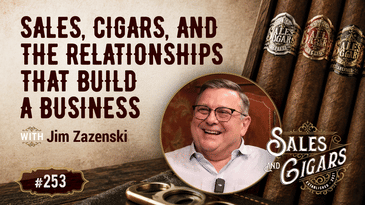
Walter Crosby sits down with entrepreneur Jim Zazenski to talk cigars, relationship-driven sales, building a high-end sign business, hiring salespeople, accountability, mentorship, and the lessons learned from decades in business.
What can a cigar shop teach you about sales, relationships, leadership, and building a business?
Quite a bit.
In this episode of Sales & Cigars, Walter Crosby sits down with Jim Zazenski at Edward's Pipe & Tobacco in Englewood, Colorado—a shop Jim has been frequenting for more than 20 years.
The conversation begins with cigars and the unique relationships that form around them. For Jim, cigar shops have become much more than places to smoke. They are places where friendships are built, business gets discussed, perspectives are challenged, and even an informal "board of directors" can emerge over a few good sticks.
From there, Walter and Jim dig into Jim's career and the growth of his custom manufacturing sign company, including its work on high-end properties throughout Las Vegas. Jim explains why his company refuses to compete simply on price, how value engineering helps protect both quality and margin, and why doing the right thing for a customer can be far more valuable than maximizing a single transaction.
They also get deep into the realities of managing salespeople: hiring mistakes, compensation plans, account concentration, prospecting, autonomy, accountability, and the danger of letting a successful salesperson become too comfortable.
It is a conversation about cigars, certainly—but underneath it is a discussion about relationships, standards, hard work, and what it really takes to build something that lasts.
About Jim Zazenski
Jim Zazenski is an entrepreneur with a background spanning engineering, operations, sales, marketing, and custom manufacturing. His company specializes in high-end interior signage and wayfinding solutions for complex properties, including extensive work throughout Las Vegas.
He is also a longtime cigar enthusiast who has spent more than two decades frequenting Edward's Pipe & Tobacco in Englewood, Colorado.
His daily cigar of choice?
A Padrón 5000.
And his philosophy is equally straightforward:
Life is too short to smoke a bad cigar.
Continue the Conversation
Want more conversations about sales, entrepreneurship, leadership, and, of course, cigars?
Listen to the full episode of Sales & Cigars here: https://helixsalesdevelopment.com/podcast/
The only smoke we blow is from cigars.
[00:00:00] Actually, my best friend in the world, I met over a stick in Sturgis, South Dakota riding my motorcycle and I had a cigar sitting in my pocket. He had a cigar sitting in his pocket. We both found out we live in the Denver area and now we are best friends. I said a salesperson is working 24-7. They have that killer instinct and that competitiveness. They're going to do what it takes. They're going to grind it out. They hate to lose more than they love to win. They hate to lose and it doesn't matter the industry.
[00:00:29] He got teary-eyed when he talked about En Fuego and Michael because he said these guys saved my life. He said he moved to Vegas to be next to his daughter and his wife. His wife passes away. He was home alone, had nothing to do. He wanted to end his life. He runs into a friend of his who smokes cigars. He said, you know, just, just, you know, look, it won't bother you. He smoked cigarettes for all those years. Come on down.
[00:00:52] And he says, I come here every day and I get to watch my games. I smoke one or two cigars a day over the course of the whole day. And it's given me a new lease on life because of all the friends I have here. So Jim, I really appreciate you helping set up the accommodations. This is the, this is one of those older cigar shops.
[00:01:17] Yeah. Right. Whenever you have pipe or tobacco in the name, you just know what it's going to be. Yeah. So when I walked into the front door, it's like, wow, this is like an old line cigar shop. And you've been a, you've been coming here for how long? 22 years. But the establishment has been in Englewood for, since 1969. Okay. And the current owners had it for about eight. The previous owner passed away.
[00:01:42] And, uh, but 22 years of joy and happiness every day, almost every day, but definitely when I'm in town and not traveling for business, it's every work day and sometimes Saturday and Sunday. They're open on Sundays. Yes. So we should, we should probably tell people the name of this shop because they're being gracious and where they're located. If, uh, you could help me with that. I appreciate it.
[00:02:11] Yeah. Edwards Pipe and Tobacco in Englewood, Colorado, right down, uh, downtown Englewood, just north of Hampton Avenue. Uh, Nick Perry is a dear friend of mine and he's the owner. And, uh, he allows me to, uh, host events like this. Sometimes I have business meetings. Sometimes I have my sales meetings back here and, uh, I'm honored to be with you today.
[00:02:35] Absolutely. I appreciate the, uh, the chance anytime. It's one of the things I can go into a cigar shop anywhere in this country. Right. And I've been into some, like my daughter went to the university of Kentucky and there's a couple of shops there. And there's one old line shop, like real small pipe and tobacco. Humidors are in the, um, in the cases for the most part. And then they have one little small one.
[00:03:05] So when you walk in, everybody turns and looks. Yeah. Right. Cause they're all sitting in that little area. They all look, what's he going to do? Yeah. What's he going to do? And then I walk into the humidor and there, when I come out with a padrone or for, you know, a cigar that I go, okay, he's going to be okay. Yeah. You know, we can relax. And then you, you can have a conversation with anybody in that room. Yes.
[00:03:34] You got nothing in common. Yeah. Right. Other than the leaf. Brothers of the leaf or sisters of belief. And, but I mean, is that like you travel a lot? Yes. What, is that exactly the same experience as you or is there ones that you've ever had a sketchy experience at?
[00:03:53] No, I can honestly tell you that I've been fortunate to travel the world in my career. And, uh, I have to also admit that I generally pick my hotels near cigar shops if I can in cities I'm going to travel to. Okay. I'm going to stop you there. How do you find the cigar shop? What's the research look like to do that? Well, in the old days I used to have the app where to smoke. Cigar aficionados app.
[00:04:20] And that was not supported after a period of time. And that's a whole other discussion we will. It's why I don't have an iPhone. Okay. Well, I get it. And, um, so what I do is I just, uh, look at Google maps and I say cigar and pipe tobacco or fine tobacco. Because if you just do smoke shops, you'll get other things that I'm not, I don't participate in. Vape.
[00:04:46] But, uh, vaping and such, uh, but, uh, for fine tobacco. And then I'll look nearby hotels and generally center in on that. So you go backwards. I do go backwards. From the cigar shop to the hotel. Yeah. Because it's a priority in my life. And it has been for many years. How many a day? Is my wife going to see this? It's up to you. Probably three to four a day. Uh, on the weekends, it could be more.
[00:05:13] Uh, but, uh, at a minimum three. Okay. And you start, you said your day, you go to the office early and we'll get to the, we'll get to the office. But you go to the office early and then noon. About noon. So yeah, I get to the office about 4.35 in the morning. Uh, it's one of the joys of owning your own business and the thoughts that race through your head at starting at three. But I, and, uh. Start dealing with them at 4.30.
[00:05:41] Between thoughts on business and at my age now, my prostate knocks and says, it's time to get up. Got it. So I just stay up and get to the office early. So by about noon, everybody knows in my office that, uh, I'm heading out to the other office. And it's one mile. I'm very fortunate that my office is one mile from Edwards Pipe and Tobacco. And I come here. And every day is a different dynamic of individuals that I get to exchange with.
[00:06:11] And frankly, there's at least two handfuls of people that I consider my informal non-paid board of directors. Confidants. Retired professionals. Uh, you know, continuing professionals. But folks that I, I trust with the inner sanctum conversations. Yeah. I don't do it in a general form. But sometimes I'll come to this background. But you develop relationships over a stick. Oh, it's all because of the stick. Yes.
[00:06:40] And whether they're smoking a pipe. And I've just recently taken up pipe smoking also. But, but cigars are the main line for me. And because of that, I have met the most, they're my best friends now all over the stick. Actually, my best friend in the world, I met over a stick in Sturgis, South Dakota, riding my motorcycle. And I was introduced by a, uh, a fellow, uh, person, uh, we had in common, but we didn't know each other.
[00:07:10] And I had a cigar sitting in my pocket. He had a cigar sitting in his pocket. We both found out we live in the Denver area. And now we are best friends. Wow. That's a great story. Yeah. And that's 20 years ago. And it, it, and all it took was the little peak. Just the cigar. Oh, it's sticking out of the pocket. Yeah. Yeah. You, and you, you know, no cigars at the office. No cigars at the office. What about home? Oh, yes.
[00:07:37] I, I created a, uh, closed in porch with infrared heating for 365 day a year smoking at my home. And it's lovely. You don't need the heating on a day like, uh, this last couple of weeks out here. No, the ceiling fans and the misters are working today at home. Yeah. I didn't realize it could get that hot out here. Uh, it's, it's happens a few times a year, but you happen to be here at the wrong time. Yeah.
[00:08:04] So I remember the first time I went to San Antonio for a sign show, um, I walk out of the, the, the, the door to go get the rental car. It's 11 o'clock at night. And the heat took my breath away. Like, uh, you know, like, like that. And there was a, a, a red cap, an older gentleman sitting there smoking a cigarette and he had a real raspy voice.
[00:08:33] He was like, welcome to San Antonio, sir. Yeah. It was like, like, what's it like tomorrow? He goes, oh, we're not going to want to go outside tomorrow. Um, but that's what it felt like when I walked out the door in Denver. I mean, 99 degrees. Yeah. And with humidity, you guys don't normally have humidity. Yeah, we normally don't have that. It's been, it's been very unusual, but, uh. So you could smoke at home in that room, not anywhere else. Yeah. Well, I, I smoke in my garage.
[00:08:58] I mean, my wife is very tolerant and, uh, but I don't smoke in the house. But like I said, I've established two areas in my home to smoke year round. Yeah. You golf? I do golf. And smoke on the golf course. How many on a golf course? One or two? Uh, at least two. Yeah. Yeah. Okay.
[00:09:20] I, so when I started smoking cigars, it was with a good friend who was a scratch golfer and I had never played. Yeah. So let's just say he had a lot of patience. Right? Yeah. Because I'd, I'd be trying to break a hundred on the front. On the front. On the front. See, I'd never played before. Sure. And you would think hitting a ball with a stick that's standing still would be relatively easy, but it, it, it wasn't. It took a while.
[00:09:50] Well, my wife will say I developed two bad habits that summer. Cigars and golf. Yeah. Um, I haven't played golf in a while, but the cigar habit has gotten much more robust. Yes. Cause I do, uh, anywhere from six to 10 cigars a day. A day? A day. Wow. Um, only one at a time. Okay. Um, although my wife snapped a picture.
[00:10:16] I was, I had two cigars sitting on, on the patio and I was walking out to my office and I had stuff in my hand. So I put both cigars in my mouth. Yeah. One was about that far and the other one was a little longer just to carry them out to the, cause I didn't want to waste them. Of course. And she snapped a picture of that. Uh, so she, she's hopefully not going to publish that cause that looks ridiculous.
[00:10:43] So let's pivot to the, to, to what you do it from four 30 in the morning to the 12th. You've got, we've got something in common there, right? You've run a successful sign business for a long time. Yeah. Um, I only ran one for about a decade. Yours is a little more robust than mine. So tell us a little bit about your business and how you got started. Yeah. Well, it, uh, it's a custom manufacturing sign company.
[00:11:14] So we're, we're kind of niche. We don't, when I say signs, people sometimes give me a blind stare and they think of exit signs or the big signs you see, uh, on the top of buildings or Las Vegas Boulevard. We have nothing to do with either kind of those signs. Uh, we do all the interior signage. So I tell people my elevator speech is, Hey, have you ever been in a big hotel and you got dropped off by an Uber or you parked your car in the garage?
[00:11:44] And every sign you look for to find your way into the lobby, to the elevator, to the front desk, back to the elevator, to the floor, which direction on the floor you need to go your room. When you close the door, put the latch on it, the back of the door evacuation. That's me. Wayfinding. Wayfinding. And it's, uh, it's an art form for very large complex properties.
[00:12:14] Um, and it's something that we got into many years ago, uh, but to the very high end clients and our Hallmark client was Caesars Palace back in the day when they had, uh, a lot more financial robustness than they do now. and they actually wanted their signs framed in marble. And when we gave them the price for that, they fell off their shoes.
[00:12:40] So the value proposition that we bring to the table is that we have craftsmen that can do faux materials and do value engineering that most shops can't do. I'd say we're the best in the country and we were able to do a faux marble finish and do a seamless frame and we were able to earn their job in their business because we molded it. Oh, you molded it. We molded it. So we created a master.
[00:13:07] We poured up some temporary molds and we poured it and we got it very organic looking and it blew their minds. And we were able to secure that account in Las Vegas, which gave us a foothold to then, well, when I tell people, they say, well, tell me a little bit about your business. I'm like, well, if you've ever been to Las Vegas, there's not one property on the Las Vegas Strip that we haven't done either with new construction or a remodel.
[00:13:35] We've done all the interior signage. So we're very proud of that. So I've seen your work. If you've been in Las Vegas, you sure have. What about the old strip? Downtown, we've done probably half a dozen of the properties. Generally, those are a little more cost conscious. And so that doesn't fit our model because we're on the higher end. Sure. And I'm proud of it. And very proud of it. Because of where you can deliver. Yeah. We don't shy away from our price.
[00:14:04] The price is the price. And if you need a better price, then there's going to be a discussion of value engineering or some sort of compromise. Yeah. Yeah. I'm not going to cut the quality or my margin because I need to be here for another 40, 50 years. And you need to keep buying up the drums. Correct. But that's a common mistake in sales, right? That salespeople will fold. Selling on price. And start dropping their price or defend their price, right?
[00:14:34] That's where it starts. And I mean, I was taught that I'm happy to lower the price if you decide that we should change something in the, what do you want to take away? Right? And that usually solves the problem. Well, I want everything I ask for. Okay. Here's the price. That's the number. And, you know, I had more of a retail type facility and it started off as a niche business
[00:15:02] where we would paint graphics on basketball courts and K through 12 markets. And then I bought out my partner and converted it to more of a franchise. Yeah. Where I did more traditional signage. We did a little bit of wayfinding, but it was more, I sub out the ADA compliance component. So, I mean, mine was more retail and we focused on some electrical, but it was those traditional signs in the construction space where our value add was, you want it when? No problem. Right?
[00:15:32] How many of those you want, colors? And then we would solve problems before they became problems. Yes. And somebody would want, I remember I would go to a retail place and they were like, I want this big, huge monstrosity on this side of my building. And I'm like, okay. The front's over there. Yeah. But you, I see you park over here, so you want to see your sign every time you walk in. Right? Yep. Okay. First off, too big. The city's not going to allow you to do that. Yeah. Right? Second off, kind of dumb
[00:16:02] because you got 35,000 pairs of eyes going by that front every day. Yeah. That's where you need to have your exposure. We can put a little sign over here that says, hi, Jim. Right? Welcome home or whatever. But that's where your business goes. So he, I remember I told him, I said, you had $15,000 budget to do this. You know, what you need is a $7,000 sign over here. Yeah. He said, you just talked yourself out of like, you know, eight grand. I'm like, nope. I'm like, oh, talk myself into a customer for life. Yeah.
[00:16:31] And he did. Everybody in his orbit was sent to me. Yeah. That needed a sign. I got a sign guy. Yes. You know, me set you up. But it's doing the right thing in sales. Yes. Which is sometimes defending the value that you're bringing. Yeah. And standing your ground. Have you always been the sales face of this, the front facing?
[00:16:56] I've straddled the role of both the sales manager and the general manager as, as the owner. It's an uncomfortable fence, isn't it? You know, my background is in engineering. So I grew up on the engineering and operations side. But I was very fortunate early in my career that I had a VP of operations take me under his wing and say, look, you're not a traditional engineer.
[00:17:27] You can at least speak in front of a crowd. So I want you to travel with my sales guys and help them answer the technical questions. We're selling pretty complicated electromechanical equipment. And since I was on the design and the manufacturing side, I would go out and shadow the salespeople. So I got to watch some world-class salespeople. Oh, how lucky. And I was very fortunate. And I was in my early 20s.
[00:17:56] And I got to travel the world with these sales guys, opening up new accounts all over the world, like I said, and watch their approach and assist when I can. And then to the point where it's long and complicated, but I came in as an engineer, became the VP of operations, and left as the VP of sales and marketing. That's quite an arc. Yeah. And I owe it all to a...
[00:18:25] It was a private company, a fabulous organization back in the early day of my career. And I just, I pinched myself because that really gave me the tools for both sides of that fence you referred to. So I can do the engineering operations. My metal fab plan alone was 100,000 square feet. So we did lasering. We did punching. We did welding and bending, all that stuff. Then we'd go to the other side and we'd paint it,
[00:18:52] power-code it or, you know, electric and then go assemble it. And then I would take it out to the field with the sales guys and demonstrate it. Because we had a sales guy at the time. He's now deceased, but suit and tie every day. And his big motto at the time was, the sale is made at the point of demonstration. So we had to be out demoing all the time. And these were big pieces of equipment.
[00:19:19] But you would be in a suit and tie demoing a piece of equipment. And to be able to cut my teeth on that and learn from some of the, what I considered the best at the time, and massive accounts that they had, Fortune 500 companies, it was a real honor. It's a great story because it, that doesn't happen as much anymore. Right? I mean, gone are the days of mentors. Yeah. People that would, your words, take you under their wing.
[00:19:49] Invest in me. Right? And because they saw something. Yeah. That doesn't happen as often as it used to. Yeah. And I've had similar situations where somebody, somebody offered to help somebody, like I sort of forced myself into the situation. Sure. Right? Because they had stuff that I needed. I needed to learn. But, you know, why do you think that's changed? Boy, I,
[00:20:19] from my perspective, I think, I've seen a lot of people that aren't really willing to put the work in. There's, there's plenty of them that maybe I haven't met, but within my circle there, it's, it's hard work. I busted my tail back in those days. I mean, it just, just finished up in a mechanical engineering degree. And maybe there's a certain sense of expectation that you're going to have this cushy job in a cubicle with a, well,
[00:20:49] I'm old enough to where there was barely a computer at the time. I grew up with T square and a slide roll. And your desk was slanted. Yes. So, but I was made the offer to go out and roll my sleeves up and maybe do stuff that wasn't that glamorous. And I was happy to do it. And, and so I dug in and I wasn't, I wasn't married. I didn't have kids. So I could easily immerse myself into that. And I wanted to learn. I wanted to be successful.
[00:21:18] I had two older brothers that were very successful, much older. There was a big gap in my family tree. So I aspired to do something on my terms, but I knew how to work hard. And you saw them do it. I saw them do it. I saw my father do it. Who, you know, he was a world war two vet, right? So he grew up in the depression and, and he was like the early forging of, well, what you should do, which is just work and no excuses. And there's no social network or safety net.
[00:21:48] You just got to go out and make it happen. Right. And so I did. So, okay. So the mentorship piece of it, there's not as many people that are offering that ability to, to see somebody. But I mean, I do a lot of hiring of salespeople, not other operations guys or anything, just salespeople. And I've been around in sales for 40 years. And what I've seen happen, there's still great salespeople. Yeah.
[00:22:18] And what it, what it takes they're willing to do, right? They have the will to sell. They have that commitment and desire to do what's necessary. And that's what makes, you know, that willing to roll up your sleeves, willing to get your hands dirty, to try something different, to really kind of understand what goes on. Like if you're selling that grandfather clock. Yeah. I don't need to know how to make it. No,
[00:22:44] but I need to understand some basics of why it dings when it dings, what the pendulum does. I need to understand that. So I sold for a long time, I sold a technical product, fire alarm systems. Okay. And I remember like, I don't understand engineering or do I want to. Yeah. Right. No offense, but it's just not my thing. Um, and I was struggling to, to grasp the control box and the initiating devices and the signaling devices.
[00:23:15] And the guy that owned the company is like, it's easy. Stop trying to make it complicated. There's a, there's a box and there's inputs and outputs. That's all it is. And there's stuff that moves on inside, but you don't need to know what causes that. You pull that pull switch. Yeah. It causes the, the outputs to go off. Okay. That's what I needed to know. Yeah. And just needed to know enough to be able to talk intelligently. Sure. And then you got to learn codes and stuff like that. But, um,
[00:23:46] what I, what I see is that there's, and this number has been very consistent for about 30 years, 6% of salespeople are what we would call elite. Mm-hmm. They're just going to do what it takes. They're going to grind it out. They hate to lose more than they love to win. They hate to lose 6%. And it doesn't matter the industry.
[00:24:11] Another 14% that are good, solid, going to make money, going to work hard, not quite elite, but they're good. And then you got another 20% that depending upon how you define average, they're above average. The rest, that's 60%. Yeah. The rest of them. Yeah. Literally. Because they're going to, you're either going to accept mediocrity,
[00:24:40] you're not going to be able to hold them accountable. Yeah. Because what's the bar to get in the sales? You can fog a mirror. Whoa. Yeah. I mean, luckily for me, because that's how I got into it. And I guess we, we see some form of that almost every day in our lives of the 60%. Yeah. Can you have a contractor come to your house? Yeah. We, we, we had air conditioning put into our house a few years ago.
[00:25:10] We had a kitchen completely gutted and remodeled. And, you know, my wife's concerned about the details and I'm listening to, I give the guy like, here's what I want. Yeah. Here's my budget. I'm ready to go. I literally told him what I want. And he was like, okay. And then he continued to do his pitch. Yeah. And I'm like, dude. Yeah. I just told you what I want. You sell it. Right. Where's your order, Pat? Yeah. I got to do this. No, you don't. Yeah.
[00:25:41] You just want to do it. No, I got to do it. Okay. And I remember I called his boss and I'm like, you lost the sale because you convinced your sales guy that he had to do it. Do the pitch with all six slides. When I was ready to buy. Yeah. I didn't really care what the price was. Cause I knew it shouldn't be in this range. Yeah. Can you do it when I want it? Can you do it? You know, cleanly. I already knew the answers. Yeah. But he had to do the pitch. He wasn't listening. Wasn't listening.
[00:26:10] Which is one of the most important things in sales. Yes. How many sales guys you got? I only have three plus myself. And, uh, in my last life, which was a much bigger company, it was a public company. I had dozens. And, uh, I used to be. Comes with a big bottle of Tylenol. I, I was tall, dark and handsome back then. If you can believe that. And, uh, and a bottle of Tylenol and a bottle of, uh, Rolaids. Um,
[00:26:41] and I wouldn't trade it for the world with my small boutique company now. Yeah. Uh, because it's a really, I, I grew up where the sale. Couldn't should be relational. And you refer to it earlier where you, uh, dissuaded somebody from spending all $15,000 on one sign. And now you had a customer for life. And if you were to look at my customer list right now, number one, we don't advertise.
[00:27:09] We don't do any trade shows anymore. Uh, it's all word of mouth. And it's just the reputation of the work we've had. Uh, we do, uh, kind of brag by posting pictures of our work on LinkedIn. And from that we'll get inquiries. Um, but the list of clients I have, uh, so my salespeople see me going out of town now because I don't have any direct account responsibility.
[00:27:38] It's to go take somebody to dinner to say, thank you for the order or to push something over the finish line. If we're, if we're just trying to get something closed up and not necessarily for the financial aspect of it, which is very important, but being a small boutique shop that everything's built from scratch, uh, I've got slots in the manufacturing sector that I'm trying to get filled. And then I know if it gets filled by something else, I'm going to disappoint somebody with a lead time. So I'll get involved with that,
[00:28:07] but that's what I'm doing. I travel around to these wonderful cities. I meet folks that I've been dealing with now for almost 20 years. And in some cases we have cigar and then dinner and then another cigar and, uh, and business is this much of it. The rest of it is this, and it's many times over this. And, uh, it's been very good to me and my company. I mean,
[00:28:36] when you're in Vegas, right, you've got customers in Vegas. Yes. Where's your go to? You can only go to one, one shop. You're only going to be there for a couple of days and you only got one evening to go. Where are you going? Well, it's called En Fuego and it's a local shop. It's owned by a, uh, a guy just very similar to Edwards. It's on Sahara, not far from the, uh, I-15.
[00:29:05] It's just to the West and it's, uh, owned by a local guy and he's got two locations, but I always go to the one in, uh, off Sahara and you walk in and it's a very similar situation. You open the door, everybody looks, you go on the humidor, you buy a few of your favorite sticks, which happens to be Padron's. Sure. Um, but I'll tell you, I was there in February for my wife's birthday. We, I took her to see the Wizard of Oz at the Sphere. Oh, at the Sphere. Yeah. It's a great place. Fabulous.
[00:29:35] It was a fabulous show, but we stayed right down the street so I could walk to- En Fuego. En Fuego. I walk in and the owner, Michael, Michael, uh, he, uh, he was sitting there and I hadn't been there in two years. It just worked out that way. And, uh, and he's kind of looking and, and, and he was the only one working and he owns it. And I'm in the humidor and I came out and he's like, aren't you the sign guy? Two hours later,
[00:30:04] we're sitting and still chatting and telling me about the, uh, economy in Vegas and things that will go on and, uh, potential for a basketball team, the upcoming baseball stadium and everything. And, and it was lovely. What, what the other thing I find interesting about those local shops is you, the owners often there, and not 24 seven, not the whole time,
[00:30:34] but every one of the shops that I've gone to like that, I've met the owner. Yeah. And we're not necessarily buddies. Yeah. But there's one in, there's one in Lexington called Jake's and, and Jake's a dude. Like it's, he's, he's the guy. And I, you know, his pictures all over the place. So I went in the humidor and he followed me in. He's like, what are you looking for? I was like, I don't know. I want something, something different. I need to, the weather's crappy,
[00:31:03] but I got to go outside and have a cigar of a short little walk. So I don't, I got to have something smaller with Bristow. He goes, oh, here. And he grabbed these little, so Ashtons, right. That were bigger than a cigarillo. Yeah. Quality tobacco cut, right. It was ready to go. And it's perfect, you know, eight minute little walk around the hotel kind of a deal. Yeah. And it was just like, this is what you need. And I didn't question them. So I took,
[00:31:32] bought a box and, you know, tried them out. They were great. Just like you said. So I went back before we left town and I'm like, Hey, I need, I need three or four of those boxes. Right. Cause they, I go down there maybe three or four times a year to see her. And, you know, I cleaned them out just because those are, those are perfect for the situation. Sure. Sometimes you need, you know, a Churchill to sit for two hours to have a conversation. Sometimes you need a little Robusto. Yes. But it,
[00:32:02] what they're true entrepreneurs. Oh yeah. And they're, they're often historian as well as a business guy that understands what's going on in the community that they, that they live in. Yeah. And it doesn't matter. Right. So that the little shop I talked about, it's a little more, more older people were seniors, more retired guys, um, retired blue collar guys. Yeah. Yeah.
[00:32:30] And the other one was everything. Yeah. Everything. Um, and I remember I was in, I was in there and there was a gentleman. They were, they're watching a basketball game. So in Kentucky, when UK plays, uh, Louisville, it's kind of a big deal. And there was one guy that was sort of holding court. Yeah.
[00:32:53] He was facing the TVs and he had this little entourage around him and he was loud and he'd had a couple of too many cocktails. Right. So, so, so carried away. And, and I remember when I was talking to the owner, I'm like, is that guy here every day? Oh yeah. Every day. Sometimes we got to get him to tone it down. Sometimes you got to like, why don't you just, you know, kick him out? He goes, oh, he spends about a hundred grand a year. Ha ha ha. Yes. Oh, so you learn to tolerate something. Yes. And,
[00:33:23] but he can talk to them. Yeah. And say, man, dial it, take the volume down a little bit and everybody's respectful. And, um, but they all have their own little flavor, you know, that you, you get. Yeah. Uh, you know, you just prompted me to remember when I was, so when I was at En Fuego the last time I was sitting just like this with the owner, Michael and on a couch right over here was an older gentleman and he had a Yankees cap.
[00:33:52] And I grew up, still am a big Yankee fan. And so. One more thing we have in common. Okay. Well, uh, I grew up and watched the Yankees in the dynasty days of Thurman Munson before he passed away in a tragic plane crash and catfish Hunter and Bobby Mercer. And then Donnie Natalie afterwards. Oh yeah. But, so of course he's from New York and he now lives in Vegas.
[00:34:22] And he offered his story and I'll just make it very quick, but he got teary eyed when he talked about En Fuego and Michael, because he said, these guys saved my life. He said, he moved to Vegas to be next to his daughter and his wife. His wife passes away. He was home alone, had nothing to do. He wanted to end his life. He had given up cigarette smoking 10 years prior to moving to Vegas. His daughter finally coaxes him out and says, you need to get out, dad.
[00:34:52] So he's out. He runs into a friend of his who smoked cigars. Said, you know, just, just, you know, look, it won't bother you. He smoked cigarettes for all those years. Come on down. That was two years ago from when I saw him. And he said, Jimmy, this place. And now he's crying. And he's, and he was 88 years old. And he stands up and he runs and embraces Michael. And that's how he, and he says, I come here every day and I get to watch my games.
[00:35:21] I smoke one or two cigars a day over the course of the whole day. And it's given me a new lease on life because of all the friends I have here. And it was just a beautiful story. Yeah. That's a, that's a, it is a beautiful story. Because it's, it's that camaraderie, right? That you, you build and it's not intentional. Yeah. Right. I mean, you, you go in to have a good time. Right.
[00:35:46] But then some relationships are formed because you're sitting there for a period of time. Yes. Right. It may not be four hours. It may be a couple hours. Yeah. But you're going to, you're going to, you know, end up into some real conversations with people that you might not otherwise. Yes. Right. And you get perspectives. Yeah. Um, I've rarely seen, I've rarely seen people get into a disagreement that,
[00:36:14] like now you see people on social media kind of losing their mind. And it happens less in person because you got to deal with the person. Yeah. But even, even so, like somebody's on the opposite side of the fence, they can seem to have more of a civil conversation. Yeah. That civility comes back because of, all right, we got this in common. So maybe we should be able to work it out. So I'm, I'm proud to admit this, that I'm on,
[00:36:43] I'm in right field, like Aaron judge, who's unfortunately hurt right now for the Yankees. But, uh, my two closest friends, the one I told you about in Sturgis and the one here are in left field. And, uh, we couldn't be further apart in the field, but we are the closest of friends. My, my innermost confidants that I talked to about personal items, uh, business issues and, uh,
[00:37:13] trust them with my life. You get the perspectives. Yeah. Right. Of, of people that are from a different, I mean, a lot of the guys I know from a business perspective, like I travel, I live in Michigan and I'm North of Detroit. And I went to the university of Michigan. So I traveled to Columbus, Ohio, which is where the Buckeyes are, which is a, one of the biggest rivalries in college football.
[00:37:42] Um, I go down there every six weeks because a friend of mine has an event, bunch of sales guys and cigars. So he's got an old line tobacco like this. Yeah. It's just a little bigger. Right. And they sell pipe tobacco. They sell pipes. They sell cigars. They sell about equal amount of each. Yeah. Right. They have different, different consumer bases. They got one whole section. It's just big lounge.
[00:38:11] So they reserve a spot for us. You bring a bottle, put it on a table and you get cigars out of the humidor. Yeah. And you're there. So it's all sales guys. Yeah. That a lot of us kind of compete with each other in a certain sense. And most of them are Buckeye fans. Yeah. Right. Or attended the university. Um, we all get along. Yeah. Right. We, we had the upper hand for a couple of years, which,
[00:38:41] you know, I know that goes around. It comes around. So I just kind of keep my mouth shut. Mm-hmm. Um, but there's some great people and they give, they give me shit, you know, but they're like, why do you drive down here? I'm like, you, it's you knuckleheads. Yeah. Right. It's this camaraderie that they get. Cause I leave the next morning at like five o'clock to get back to my office so I can catch, you know, mid morning meetings. Yeah. But it's just because of that. True.
[00:39:10] And a couple of them come up and we do events in, in my cigar shop in Detroit. Right. So, so you have, let me ask you this. To me, there are different kinds of cigars. Yeah. Not the brand. Celebratory. Yes. Contemplative. Yes. Right. And then, and then that, that one you just have because you're coming to your second office. Yeah. Right. Which can kind of do both. Right. Is that, is it, is that something you find or is there another one I'm missing?
[00:39:41] No, I think you some, I think that actually I never gave it much. Thought, but I think I do it just naturally. Um, I think the more contemplative thought is when I'm at home by myself. Yep. Is, and I have a selection of cigars I have for those moments and very special ones. And, uh, and then when I come here, uh,
[00:40:07] there's times when I come in with nothing on my mind and everything's good or not bad. Right. And you just show up. And as I said, every day's, uh, a different, uh, group. There's a few of us that are constants and all it takes is one other person to come in and completely change the dynamic. And I don't mean that in a bad way. And the, they bring a different energy. Oh my God. And the conversation will go in a direction you had no idea or the,
[00:40:35] the thought process would bring you to something. So, um, I'm a big believer that life's too short to smoke a bad cigar. And, um, this humidor here at Edwards is huge. Yeah. There's a lot. It's a great selection. But I'm also the kind of guy that eats oatmeal and peanut butter every morning, every day. And I don't get tired of it. So I have my cigars that I go back to every day. Sure. And,
[00:41:05] um, and depending upon the context, conversation, uh, or who's in the room or the humidity of that day, they all taste different. Sure. but, uh, the ones I smoke at home are, and when I'm by myself, or even if my wife's in the vicinity, uh, those are the ones when I'm really trying to maybe do some problem solving either for work or life issues or whatever's going on. Yeah. And here is, is, uh, uh,
[00:41:33] more of a social situation. Uh, but I'll tell you the reason why I found this place 22 years ago, is my sales guy. And I, um, at the time, he's the only one that I had in my office at the time that smoked cigars. And, and he was an early riser also, and he'd get there early and he'd grind away. But by about, back then it was about two o'clock. He's like, uh, cause he wouldn't get there at five. And back then I didn't get there at five either. This is going back 20 years ago. And,
[00:42:03] um, he said, Hey, let's go over to Edwards and have a stick. And we can talk about what I did today, what I got this week. I got trips coming up, any advice. And so that's how my routine started was because of my sales guy and us talking about sales. And, uh, from that we were, we were much smaller back then. And as we grew, the next guy I happened to hire happened to be a guy. And he happened to smoke cigars also. Without intent? Just happened to be.
[00:42:33] Was it a question in the interview process? No, no. Um, it was a point of discussion later. It wasn't a direct question, but it was like, Hey, what do you do for hobbies? Uh, what do you do to relax? And, uh, cigars come up. So, I mean, heck, I'm only married five years. I'm a late bloomer. Okay. Um, and I have to tell you that, that, uh, I knew my wife, now wife in a professional setting. First, we sat on a, uh, uh,
[00:43:01] board of a local private company that needed some assistance and she knew the owner. I knew the owner. We didn't know each other. So for a year, uh, so four times every quarter we'd meet. And this is much later in life. I was 56, 57 years old. And, uh, anyway, so I got to know her. I got to really respect who she was as a professional. So, so I finally got the nerve to ask her out and we went out for brunch and they delivered the drinks.
[00:43:32] And I said, well, before we take this too far, I respect you too much. Let me, let me just tell you a little bit about myself. And I said, I like to do this. I like to do this. I smoke cigars every day. I ride motorcycles. Uh, and then she went through and said, well, I've never been with somebody that rode motorcycles. Um, I've never been around firearms and I've never been around somebody with smokes, nevermind cigars. Well,
[00:44:01] now she's my wife and she's got all the gear and loves to ride on the back of my bike. Uh, she has her own concealed carry and is probably a better shot than I am at this stage. And she usually are. She's amazing. And now, um, she'll go to any cigar shop in the world with me and we sit there and sometimes she'll smoke a little cigarillo. But if not, she sits there and enjoys the environment because she knows how important it is to me. And she enjoys the environment. I mean, some of the shots we go to in, in the nation, in the world are just, they're beautiful. Yeah.
[00:44:31] And, uh, she enjoys it. What about, I mean, that's a great, that's a great story because it also proves one other thing. Hello sales guy. Cause you dealt with the objections before they became objections. I put it right out there. Yeah. Yeah. Got it all up front. Yeah. And if there's going to be a problem, let's talk about it now. Yeah. And, and exactly. Cause you haven't even paid for brunch yet. Exactly. And, uh, brunch lasted five hours. Wow. And, uh, a year later I proposed to her. Beautiful story. So.
[00:45:01] Beautiful story. Yeah. And every once in a while she'll have a little cigar. Oh yeah. Yeah. And, uh, the very special cigars that I enjoy, you might appreciate this. Um, working with Nick here at Edwards, she bought me the entire box of the Padron Fuente collaboration. That. Oh shit. Yeah. Wow. $8,000 box of cigars. She bought that for me for my birthday that year. Nice. So those kind of, I bought a special humidor just for those.
[00:45:30] And because they were a very limited run. Absolutely. And so, uh, that's what she, she. Wow. Yeah. That's a special lady. Yes. Oh, I'm the luckiest man in the world. And what did you do for her birthday? I took her to Hawaii. So. Okay. Four seasons if that matters. So it did help. It kind of counts. Yeah. Kind of works out to be about the same price. But I couldn't smoke on the beach. I had to smoke in a hut around the room, around the corner from our room,
[00:45:59] even in Hawaii. It was a. They won't let you smoke on the beach. No. So that's all right. I still got to smoke. So. I remember I was on Coronado Island, you know, off San Diego. And. I'm walking down the beach. Seven o'clock in the morning. There's nobody out there except for the seals swimming in the, in the ocean. Yeah. and people yelling at them. And I'm, I'm just walking up and down between there and hotel, hotel Coronado.
[00:46:29] And. Just cop. Cop walks out. And he's like, you know, you, you can't smoke that here. I'm like, what do you mean? Like, I'm, I'm outside. Yeah. He's like, yeah, you can't smoke that out here. I'm like. On the beach. Yeah. And he goes, it's going to mess up the sand. And I, and I was being respectful. And he was being super respectful. He goes, it's, to be honest with you, kind of a dumb rule, you know,
[00:46:59] when, especially when there's nobody out here. Yeah. But, um, I had to tell you, cause I saw you. Yeah. And I'm like, all right, I appreciate it. I mean, I got just a little bit, I'm going to walk kind of slow back to the hotel. Cause that'll be fine. I just don't throw the butt in the ocean. Yeah. I'm like, I wouldn't do that anyway. Yeah. Same thing happened in New York city. Yeah. Yeah. Walking through central park. Yes. Cop walked up to me, says, you know, you can't smoke that here. Like, you serious? He's like, yep. He goes,
[00:47:28] I'm going to go that way. If you're still here, when I come back, I got to give you a ticket. All right. How much is the ticket? It's a hundred bucks. All right. I'm going to go that way. And I, you know, finished my cigar, walking up on fifth Avenue. But, but in San Diego, you could smoke on the street and there's plenty of, you know, in the gas lamp district. Yeah. There's a couple of cigar shops there. Yeah. But not on the beach. No. It's just dumb roads. As an aside,
[00:47:57] we did the remodel of the hotel Del Coronado. So we did the signs. Yeah. Another place I've seen your work. Yeah. Um, so I usually like to ask a question about a sales situation, right? Cause I talked to a lot of entrepreneurs. Yeah. And is there a lesson learned and you don't have to give away the whole story, but something that went sideways on you. Maybe you saved it. Maybe you didn't,
[00:48:27] but you learned a lesson that informed you to help you in the future. Cause we, I have a lot of entrepreneurs who listen to the, um, to the podcast. Yeah. And it's mostly entrepreneurs and have some bent towards cigars. So you're a, a wise and sage business guy. Well, I know I'm putting you on the spot. Yeah. No, it's not related specifically to a,
[00:48:56] a given sale. It's more of an account issue. Okay. If that accounts fall in that category, um, we had a period of time where there was a specific, uh, category of signage, digital signage when it blew up in the late, late two thousands, 2010 digital signage was becoming such a big deal. And we, uh, I had a very,
[00:49:27] I wouldn't put him in the top 6%. He would have been in the other 14%. Okay. He had the capability to be in the 6%, but, um, didn't have the discipline. And I probably failed him too. I didn't, uh, spend enough time with him because we were so busy when I was trying to straddle that fence. I was maybe spending a little too much time on operations because we got so busy because of the explosion of that particular category. But anyway, we had a client that, uh,
[00:49:57] blew up overnight and because of the compensation structure. And I do believe salespeople should be the highest paid people in the organization. Well, comp plan is a set of instructions. Yeah. So what am I thinking? It's the marching orders of, hey, for success to, uh, to, to meet your financial plan, which is my responsibility. And you need to go execute that with those. But they have to align. Yes.
[00:50:27] And, I see a lot of organizations that don't know how to pull those together. And unfortunately they either fumble or fail, but, uh, I'm pretty good at that alignment. Maybe not always great at the execution, at least back then. Now I'm a little, because of failure, I've learned. Nevertheless, um, I allowed the salesperson to, um, uh, mine that shaft so well
[00:50:56] at the expense of what are we going to do if this drives up someday? And so I woke up one day and I looked at my sales and I had over 50% of my sales with three clients. And I didn't sleep for quite a period of time. Yeah. Uh, fabulously profitable. Sure. Because the business, there was no, no cost of sales at this stage.
[00:51:24] We were just taking orders. So, um, and I was, uh, negligent to not push that particular salesperson to go recreate that as hard as it is. And maybe you never do, but if you get three or four base hits, as opposed to the grand slam, we're still going to get to the same place. You're going to work a little harder, but it's for the betterment of the organization. And it took me two and a half, three years to,
[00:51:54] um, to, to figure that out, have a few heart-stopping moments when the competition finally woke up and started calling on them with that better price. And I wasn't going to lower price. I was, yes, I wasn't going to lower my price and, uh, to get that replaced. And so I look at it as an equal failure on my side from the management of not pushing and the salesperson being complacent and,
[00:52:24] and seemingly working hard. Oh, I'm taking so-and-so to the ball game. I'm doing this. I'm doing that. I'm doing their trade show. I don't want to say it was at a point of diminishing returns, but it was comfortable. It was cozy for that person, whereas we should have been out plowing new ground. Yeah. So to me, that's, um, your salesperson who sells the most is rarely the best salesperson.
[00:52:54] Right? They've got the biggest accounts. They've got the, uh, that fat, dumb, and happy kind of feel about it. Not that there's anything wrong with that, but that, and that's really not their fault. Right? It falls to us as entrepreneurs to help them change those behaviors. Not, you know, stop paying them on the account, right? Yeah. They earned it. But how do we tweak that comp plan to create
[00:53:24] them to go do that again over here, right? Well, and that's what I did is I modified his comp plan not to hurt him over there. Right. because we were all winning, but gave him extra incentive over here to go find- A couple more points to go do new account. To go get new account. Business development. Correct. Right? And that's one of the things I see a lot with sales, with the sales leaders and entrepreneurs is that everybody's got the same plan, everybody's got this territory thing and like
[00:53:54] we never analyze it. And I think we should be analyzing that on a quarterly basis so that we can make an annual decision. Yes. Not that we want to tweak a comp plan, right? every year, but we want to start to look for trends. We want to start to see, holy shit, 17% of my revenue is coming from these three accounts. Yeah. Can't have that, right? And when it gets to 50- Right, but I'm saying that if we learn at 17 we can start to manage it a little bit. Yeah.
[00:54:24] Because your sales people aren't going to notice that. They just want the commission checks. And I agree with you, not every entrepreneur thinks that, you know, if I write them a big commission check, you know, that's money out of my pocket. No, it's not. No. It's a dollar, you know, that his company gets his revenue and they get a little piece of it and you should have your margins situated so that everybody wins. The customer, the company,
[00:54:53] and the salesperson. One of the biggest challenges I had coming into the sign company was this, albeit smaller, this incredible group of craftsmen that can make anything. And they had the identity that they controlled the business. And because we're a custom manufacturer and we have nothing in stock, I had to remind them that, and we all know
[00:55:23] the saying, nothing happens until somebody sells something. And it took a while for me to get that psyche to change to realize we're on a team together. It's offense and defense. We either win together or we don't. I never use the word lose when I'm in company meetings because we're not losers. We just didn't win. We didn't win today. Tomorrow's a new day. Right. And as a salesperson, as you know, now, some people say you start the morning
[00:55:52] every day with zero, zero. I'm not that way. Maybe it's the analytical side of me and the engineer side. You know what your quarterly goal is. You know what your annual goal is. So if you didn't get a good amount of sales last week, last month, last quarter, that gets tapped on. So when you wake up, I mean, it could be in the hole. That heaviness is a hole sometimes. Now, granted, you know, you started the year and I sat down and approved your plan. So I knew where you're going to go get your business. And so let's work on that.
[00:56:21] Let's go, let's go cultivate what you said you were going to get to make up for that because, you know, we can't recreate time. We can't make more time, but we can get bigger orders. And hopefully... You get more of a good sized order as well. It's an interesting thing with... So I, I started working with a client about six years ago. They were doing about 5.9 million. This year, we're going to do 19. And when I told the salespeople,
[00:56:51] like, your goal is 8 million and your goal is 3 million based on their territories, they were like, no way. You're crazy. It's impossible. Okay. Let's just, we're going to sit down and work through it. And I would just work through like a cookbook with them, right? We go backwards. What do we know that's coming in? Because we can forecast what's going to happen based on that account. What did they tell you? What is the intelligence you've gathered? And we got them to realize that out of the
[00:57:21] $9 million sales goal, they really had to go find a million and a half. True. So all of a sudden, it's not so terrible. Yeah. Right. And by the way, maybe it should be 10 because you only find a nine and a half. Sure they loved you early on? No. They're still not a big fan. They respect the fact that we're, we're, they're earning more money. Yeah. Right. And they respect the fact that, you know, I'm not always, you know,
[00:57:50] Mr. Warm and Fuzzy, but they realize that my goal is to get them to be better so that they can earn more commissions. And that's what seems to be happening. Yeah. But it's, it's just a little bit of planning that makes a difference. So, is there anything that we didn't cover that, that we should have covered about cigars or business? I mean, what's your daily? You and I talked about that before. My daily cigar? Yeah. Uh, Padron 5000. Mine's a four. Okay.
[00:58:21] And, uh, uh, is there, do you have, so I, I have a bit of property that I live on and, and I still go out and cut my own grass, right? It's, it's a, it's mine candy. I don't have to think. All I gotta do is not run over some flowers that my wife's got in place. If I do that, I'm, I've gone, okay. But I have a tractor cigar that I use because if the tree hits me in the face and it falls off, you know, I'm not throwing away a $20 stick.
[00:58:51] Yeah. you have a tractor cigar? A Padron 5000. Ha ha ha ha. Ha ha ha. Okay. Got it. So when I'm smoking today, you have standards. I got it. Well, again, life's too short. I had to smoke a bad cigar. And, uh, early on, I tried a bunch, uh, reps would come in and do shows and sample. And, uh, I'd be polite and I'd try to smoke it all. And I realized I'm never gonna get that time back or that opportunity to smoke a good cigar. So,
[00:59:20] it's not a bad philosophy. I just kind of stay in my lane. Uh, today I'm smoking a Padron 1964 number four. Okay. Which is one of my favorites, um, in the Padron series. Uh, it's a bigger ring gauge and, uh, more full bodied. And, uh, I blend that in with my number, my number fives. But my wife laughs at me because I grew up in northern New Jersey, right where they filmed The Sopranos. So on the weekends, unfortunately now
[00:59:50] we have water restrictions, but, um, and I don't have a big property, but sometimes I like to fertilize or just hand water in between the sprinklers. With a cigar. And Saturday morning I'll be out there at seven in the morning in my shorts and my sneakers and cigar hanging out my earbuds in and I pretend I'm Tony Soprano standing there. In northern New Jersey That was such a great show on Sundays. Yes. I know I would go out
[01:00:19] and sit in my cigar lounge, right? And it was like a thing, right? The music was up loud so you could get that, that first burst and then when he was smoking that cigar as he was driving through town, right? I mean, that was just like such a great show. Well written. Yes. David Chase was amazing. He's brilliant. Yes. And if, you know, if Caldefini hadn't, if we hadn't lost him, I think there would still be a movie that would have been made. Yeah, I agree.
[01:00:48] But Chase didn't do it because it wouldn't have been right. Yeah. Right? And he could have made a ton of money. It wasn't important to him. No, it was all about the quality, which is much like the cigars we're smoking. Yeah. I had a chance to meet Mr. Padron once and his Spanish was about, his English was about as good as my Spanish. Uh-huh. And I remember we were talking through the rep who introduced me. It was just like a three minute conversation.
[01:01:18] Oh. And I'm like, how do you, how do you cut? What's the, what do you recommend cutting, you know, the Padron 4000? He went, really? That's how he cut his cigars. Really? Because when he was in the field. Uh-huh. And, you know, they didn't always have the equipment with him. Sure. That's how he would cut his cigar. Interesting. It was just like, I mean, and he was a legend. Oh. He's, I have his book and his paraphernalia and like I said,
[01:01:48] that beautiful humidor that, or the, yeah, presentation case. It's a beautiful gift that your wife gave you. And that's the other thing, maybe we'll end it on this. When I've gone to the big smoke, right, um, watching the guys who own these brands, doesn't matter if it's Fuente or Padron or Oz, they all like each other. No. It's not fake. It's very fierce. So I don't,
[01:02:17] I don't mean to hijack the topic, but I was fortunate two years ago, Nick Perry, the owner, invited me, uh, to go to the Perdomo factory tour. Okay. And Nick Perdomo himself did the tour down in Nicaragua. Okay. So we flew down to, uh, uh, Esteli. And, uh, there was probably 20 of us in the group and most of more retailers and some VIP clients. I happen to be the VIP client of Edwards cigars and, uh,
[01:02:47] felt very fortunate of it. But getting to know Nick Perdomo, number one, he's an intense guy anyway. I mean, when you consider the fact that he started his business out of his garage in the early 90s and now he makes a hundred thousand cigars a day. Yeah. Uh, you don't do that by just being lazy or laid back. He is intense and, um, luckily I didn't bring it up, but there was, as we were in, uh, his factory
[01:03:17] sponsored bus from the hotel he had us at to his fields, there was a sign for Padron. And Padron doesn't do factory tours, but somebody said, hey, what about Padron? And let's just say that his comments, uh, mirrored that intensity of competition and he, he wants to rip everybody's heart out and he's a true salesman. I mean, and he is, uh, an entrepreneur and, uh, uh,
[01:03:46] his sales efforts because I travel throughout the world, Europe, and Asia and his cigars are in Europe and they're in Asia. I'm sure they're throughout South America and they're all around the country. So he's doing something right. And they're a quality cigar. Yeah. If people really think about what goes into making a cigar, right, it's five to seven years for a pretty standard cigar. Correct. Right. And then, you know, if you get one that's been aged for a while, right, and this, you know,
[01:04:15] and done well in 20, 30 years of tobacco. It's, and how many times human hands touched that leaf. It's incredible what, what it translates to for the pricing at the retailer. Yeah. I mean, it's, it's almost not fair. Exactly. And what, and what, you know, I'll say this, what the government is charging because they think they can get away with it, right, because they think they can control us, right, is totally unfair to the industry. It's just total
[01:04:45] horseshit. Yeah. So, so let's, let's go to sales hiring in your business. Over the years, if you think about it over the years, do you hire salespeople in a similar fashion that you would hire an operations person? No. Good. Yeah. What's the difference? Um, well, I think it's apples and oranges. Apples and oranges. Pineapples. Okay. So, it's, um, but I, I wasn't always
[01:05:14] very good at it and I've made some big mistakes. It's not natural. No. Um, I've never had a formal class on how to hire a salesperson, maybe to my demise. Um, you run a successful business, probably not a big problem. I've been fortunate and we work hard. Uh, but again, I, I lean more on the relationship side. I think there's a lot of industries that don't need that as much. They're more transactional. Uh, but I've always
[01:05:44] been involved in my three major steps in my career. They've been very high priced, high value, high margin, uh, products or services. and so, uh, very non-transactional, very relationship, uh, driven. And, uh, a number of years ago, I had a salesperson that wasn't cutting it. They weren't hitting their numbers, their accountability. I'd sit down personally and,
[01:06:14] uh, almost, well, weekly, uh, looking at their numbers and trying to work the plan that we both agreed upon at the beginning of the year and for a number of reasons we weren't getting there and I, I came to the decision that this person wasn't going to make it. Therefore, the organization needed a change and, let them be successful someplace else. Yeah. And so, I sought out through my network, hey, do you know anybody? And, uh,
[01:06:44] a name popped up from the cigar shop and, uh, fatal flaw for me. I fell in love with the resume of work and the institution that he graduated from. Oh, yeah, that's a big one. And, I was enamored that he was a Notre Dame graduate in marketing and he was currently in a marketing position
[01:07:14] when I interviewed him and I should have known better. He wasn't happy and he wanted out and he was savvy enough in the course of my conversation with him to tell me what I wanted to hear and I bought it and I made the change and, and in a small organization like mine, that's a big thing. It's a big transition when you only have three salespeople beside yourself. But you're dealing with a human too, right?
[01:07:43] So there's that element to it. of course. Of course. Anybody that says it's easy to fire somebody for non-performance has never had to fire somebody for non-performance. Well, and I'm an empath and so I feel it at a deep, deep level. I take it very personally. I think about the person and what's behind them, the wife, the kids, the, the, whatever it is. Tell their spouse. Yes. And how are you going to make their car payment, their mortgage payment, the kids' braces, whatever the case is. I think about those things and so I brought the person on and,
[01:08:13] uh, I willed it to happen and we had some early wins because he inherited some jobs that were in, in the pipeline and so there were some early wins and then there was the drought because he didn't know how to prospect. He didn't know how to go. He was afraid to make the call. He was waiting for the phone to ring. Sure. Huge difference and, and, uh, I wound up two years. Two years? Well, a year and a half, but two years for the full turnover
[01:08:42] for me to finally realize I got to make a change and it, uh, I hurt the, I hurt myself at that stage and him and his family and his progress. That's really an important factor that you, when we, when we keep somebody on too long, we're hurting the rest of the team, we're hurting the individual and we're hurting the company and probably your customers. All the above. So, I'll share with you like, it's my philosophy, I won't get into
[01:09:12] all the details, but, I work with this framework that I've sort of created. Attract is the, is the first part of it. When you look at a job posting for a sales job, it's usually a job description that nobody freaking reads. Yeah. Right? They're looking for what the company is and what they want me to sell. It doesn't say anything to the candidate you want. I want a candidate to read the job posting and feel like, oh,
[01:09:42] that's me. They're describing me. I got to hire, this is my job. I got to go get it. Right? That's what I want. I want to attract and I want to repel. Right? So, what do I do in the ad? What you talked about earlier with your wife. Here's all of the things that could be a problem. So, in the job posting, it's really a Shackleton style ad. Right? So, Admiral Shackleton was the guy who went to Antarctica. So, he posted like a really short ad. You can like look it up and I should have it memorized,
[01:10:11] but it was basically a dangerous voyage, unlikely to return, but if you do great admiration and notoriety. So, he's basically saying you could die. Right? 5,000 applicants of crazy sales are going to do this. So, that's the model. So, we're going to tell them you need to, this is what you need to do really well. This is what is really tough about the role. And, you know, here's what the comp looks like. Right?
[01:10:42] I need you to be at two and a quarter in 18 months on target earnings. Right? And, kind of set it all up like that. So, it doesn't look like anything else. And, I want that self-identification. So, that's the track. Select is, we have a process where we do, I don't look at the resume. So, I don't fall in love with the resume. We do, I use a specific sales assessment that's only for salespeople, not personalities, not behaviors. Just,
[01:11:11] do they have the skills and the mindset to do the job? Because we can teach them the sales in our product. Right? But, I want to make sure that they have that will to sell. So, we're going to select the right person. Think SEAL Team 6. Yeah. Right? You don't, you get invited onto that team. And then we're going to hire them, which is the traditional thing. Right? And up until this point, I'm not selling them on the company. You got a great company, probably has a great culture. Right? You're running it. You're happy. You're smoking cigars. You're celebrating wins with the cigars.
[01:11:41] Right? Maybe some bourbon from time to time. Yeah. So, that's where we sell. This is a great company. It's a great job. This is why we want you. Now we sell. And then the retain. Onboarding somebody is not orientation. We're going to onboard them by teaching them who our customer is, what they care about, what their pain points are, what keeps them up at night. They have. And then we teach them about our product. Got to teach them
[01:12:10] the customer before we teach them about our product. Sure. And usually that's the reverse. Right? And I, there's one job I had for 10 years. I quit on day two. Yeah. The VP of sales said, here's three books. Go read these books. Okay. So I go to my cubicle. And I open up the books and I'm looking at them and they're engineering books. Electrical engineering books
[01:12:40] with formulas and Greek letters and all the stuff that I hated about calculus. So I sat there for two days looking at them. So I showed up. Nobody was ready. Nobody took me to lunch. It was just an awful experience. So second day I threw the books on his desk. Said, I think we made a mistake. What are you talking about? If I got to learn this to be successful in this role, I'm not your guy. I'm not your guy. And he said, who do you think you are? I'm the guy that's not going to learn that. Yeah.
[01:13:10] What do I need to go talk to? I need to go out in the field and talk to people. What do I need to know? So I had to force them to teach me what I needed to know. Right? So all of these dumb things that have happened to me over time and I've had some good mentors to teach me. But that's sort of the philosophy that I have around sales hiring. Yeah. And it's don't fall in love with that resume. Don't. Industry experience is really a trap. Sure. Right? Having somebody in the sign business Yeah.
[01:13:39] likely to get a retread. Right? It's a bonus if they understand the industry. But let's make sure they know they have the mindset they have the will to sell and some basic skills. And we can teach them the sign business because we both know that it's not complicated. Right? Yeah. My sales people now came from totally different industries. And when you have to reinvent yourself you got to really invest in who the buyer is what they care about. So here's
[01:14:09] like one last tip. about sales hiring. If you're if you're thinking about hiring a salesperson and you're selling to a facilities manager let's just say Wow. Who else calls on a facilities manager? Right? If you're selling this widget there's somebody else selling another widget. Those guys already know your buyer. Right? I'm old so they probably have a Rolodex. Yeah. I have a Rolodex. I have three.
[01:14:40] They're all safely put in a drawer. Smithsonian might want them someday. But they're but that's what I'm looking for. I want them to know my buyer. Right? I could teach them the business because I need them to know my buyer. So that gives them a leg up. Yeah. If they know the industry and they've got the skills yay bonus. Yeah. But I want them to know that buyer. Yeah. I think I think those things the mistake you made you identified right away. Yeah. And then we're salespeople
[01:15:10] we're usually better at interviewing than the interviewers. Yeah. It was probably one of the lowest points in my career and I've had a few. It's a mistake. And luckily because of the rest of the team and myself and the momentum of the business we were able to work around it and he transitioned out to a position that made sense for he and his family and the person that I have in there
[01:15:40] now is still there and very successful. Oscar Wilde once said experience is the name I give to my mistakes. Yeah. And I might have a corollary to that because I'm a really experienced guy. I've been doing this for 40 years and that's why I tell salespeople I've made all of the mistakes that you're going to make and you're going to make mistakes. Yes. I've made them four or five times because I'm a slow learner. Yeah. Right? We're going to help you only make them once or twice. Yeah. So let's talk accountability.
[01:16:09] Yeah. What's your what's your basic philosophy around accountability with a salesperson? Well, it's a double-edged sword in the sense that I give my salespeople a lot of freedom. Autonomy? Autonomy. Autonomy. As long as they're hitting their numbers and they have the ability to call upon me to help at any time in the sense of
[01:16:39] they just want to chat, they want to vent, they want to bounce ideas off, they want me to go with them to visit a client. I'm there. They can take the time they need to do whatever they have to do. I know there's some small business owners or sales managers that resent the freedom that some or the autonomy that some salespeople get. I'm a firm believer that they have an entrepreneurial spirit. They have to manage these relationships. They're running a business within a business. Correct.
[01:17:09] And so, with that freedom, the autonomy, the luxury of setting their own schedule. And again, I like to remind the operations people that generally have a very specific time to come to work and go home that a salesperson... They resent that, right? Big time. And I said a salesperson is working 24-7. And even,
[01:17:37] at least in my experience, very successful salespeople very rarely, they're on vacation but they're checking their phone, they're checking their orders because they have that killer instinct and that competitiveness. And so, from the accountability side is you got to hit your numbers. And you can have a bad quarter. You could have a slow second quarter but if you can't, if we can't see
[01:18:07] a win at the end of the year, this isn't going to work. And so, from that standpoint... But I don't wait until it gets out of control because... But you set the expectation up front? Oh, very, very clearly. Yeah. Because you've talked a couple times about the plan that you've agreed to at the beginning. Yeah, because I set the financial plan and it's my money. But then you help them set a plan to achieve their goal. Oh, yeah. We sign off on it and it's not a legal contract but it's a memorandum of understanding.
[01:18:37] It's a plan. This is what your numbers are. You agree to that. Yes. Okay. And this is where you're going to do Q1, Q2. Because even though I'm a private company, I came out of a public company. So, I live and die every 90 days. And it's been very successful for me that we do that. We close our books every month but every quarter end, I have a milestone that the company needs to hit. And it's all based on the overall plan. And obviously, top line revenue is kind of important
[01:19:07] in that plan. It's important and obviously, they have a certain wiggle room on the pricing. So, I know my margins are going to be strong or where they need to be at least at the top level. Down there, they don't have any control over anyway for the net margin. That's my job. So, you set the clear expectation of what has to happen. Yeah. Right? That's the first part of accountability that's usually missed. And it's up front. In writing. In writing. And we both sign it. Okay. And we post it up. How often do we look at that?
[01:19:37] Well, when I was more hands-on, we'd do it once a week. We'd have a sales meeting and we'd sit there in front of the screen. I go back to the old days of a Rolodex and then when it went to Goldmine. You remember that? Yep. It's okay. We've advanced past that. I was used ACT before Goldmine. Okay. We went the other way around. We had Goldmine, then ACT. And so now, I use a Microsoft product, but it still works for us. I use Microsoft Dynamics. Dynamics, yeah. But it works for us. But every week, we sit down,
[01:20:07] I look at their pipeline, I look at the probabilities, where they're at, what we're going to close, where we're at for the week, where we are for the month, where we are for the quarter. And everybody's in the room together. And then we have one-on-ones. One-on-ones twice a month? Once a month? Weekly? Once a week. Nice. Once a week. It's really robust. Well, when you're a small, self-funded organization like me and I'm writing the checks, I want to know what's happening. Okay. There's nothing wrong with that, even if you're not writing the checks.
[01:20:37] Well, yeah. Nothing wrong with that. Yeah. Because, to me, closely managed and micromanaging are wildly different. Yeah. Right? Because you earn your autonomy as a salesperson. Yes. And I remember talking to a salesperson who, she was fat, dumb, and happy. Right? She hadn't opened up a new account in four years. COVID hit.
[01:21:06] You had to defend and you had to go find a great opportunity to go out and get business for other people. Yeah. And I told her, like, you know, you keep hitting your numbers, life is grand, you can kind of, you got a lot more latitude than others. Yeah. That's fine. But the minute you lose, you start losing, you work for the company and you're going to be held accountable to the same standards as everybody else. Yeah. Right? Because I inherited that. So I had to kind of give some latitude.
[01:21:35] And she did not like it. Yeah. When accountability came into place. And I would be like, here's the plan for the year, here's the forecast, right? Everybody agreed. We worked the cookbook with them. And on a monthly basis, all right, last month, you're on target. Great. Short meetings. Right? The accountability was there. You hit your number, your pipeline looks strong. Keep it up. Yeah. We're done.
[01:22:05] And then I would look at another salesperson. You didn't hit your number last month. This month, it looks pretty strong. Right? What did you do different last month? Well, there was this thing. Okay. Well, how do we avoid the thing? So I'm looking back. I'm looking forward. Doesn't look like there's going to be a problem. Looks robust. Looks like you're going to make up the 10 grand you owe me for last month. Yeah. So this is good. But this is where they usually get squirrely,
[01:22:35] right? Because you didn't hit your number. Your pipeline looks really unhealthy. I got to start looking at what you're doing. Yeah. And what you're saying. Yeah. I don't need to be micromanaged. I'm not micromanaging you. We looked at your number. We could have been done. We're not done. I looked at your pipeline. It's a mess. You got to start looking at, like, are you having enough meetings? Are you making enough calls? Are you creating urgency? Are you finding the compelling reasons to get people to write in?
[01:23:03] And they self-select out because they don't like depression. Great salespeople love the accountability because it's a pat on the back most of the time. And you've earned the right to have a bad month or a quarter. Well, sure. Yeah, absolutely. We all do. You know, I'm a firm believer that you can't manage it if you don't measure it. 100%. And I appreciate your distinction on the micromanaging. I don't micromanage.
[01:23:32] I look at the numbers. Numbers don't lie. And when they ask for help and if they're doing well and they ask for help, great. If they're not doing well and they're not asking for help, problem. I'm really... And I don't want to let out too much leash to where it becomes fatal to the organization or to them because it's going to be to them first. And so, my weekly meetings were not oppressive. They were meant to celebrate what we're doing, how we're doing
[01:24:02] and understand the synergy among the team even though, of course, there's rivalry among salespeople. You may be on the same team but everybody... A sales meeting is like an Italian family dinner. There's a lot of yelling. Yeah. Sometimes there's food being thrown but nobody else comes in from the outside. There's no operations guy coming to that meeting. Oh, they're afraid. Right. They want no part of that. Right. Because they're afraid of that room and to my operations people it's like
[01:24:31] if you ever walked into your job and not had anything to do... Yeah. Right? Like, they walk in every day. They gotta go create something. Yes. From nothing. Out of absolutely nothing. Yes. So, they're working differently than you do. Yes. And yeah, they spend some time on a golf course and maybe they spend some time at dinner and their expenses are bigger than yours but they're creating something out of nothing. Yeah. So, you... You got... If you wanna do that
[01:25:00] come on over for a couple of weeks. Yeah. We'll show you what it's like. We'll teach you how to make cold calls. Yeah. See how that works. Yeah. And they usually back out of it. They still resent it. That's okay. I'm fine with that. But it's a... If it was easy to do well, everybody would be doing it and it's not easy to do. That's why there's only 6%. Yeah. Right? And that accountability piece, right? That autonomy... I think the salespeople know what they're doing.
[01:25:29] I can give them some... leash as you would say, right? Well, if you give a dog too much leash, they're gonna run into the street. They're gonna run into the... Get tangled up and with a stroller walking by. Yeah. It's a big mess. So they gotta earn that autonomy and then they get a little latitude. Yes. From time to time. But if their plan is to be opening up three new accounts a quarter and they didn't do it, that's a problem. Big problem. Because it's gonna come home... Those chickens come home to roost. Yes. Because again,
[01:25:59] numbers don't lie. It's a... It's the best part of sales and it's the worst part of sales. Yes. Right? Because those numbers translate to your bank account. Exactly. Because you get... There's always like... You'll appreciate this. I've always was like... You're excited when... You get the agreement. The handshake. Wow. Hey, we're gonna close this deal. Paperwork's gotta be signed but you know that the guy said yes. Yay. That's the first excitement.
[01:26:28] You got to close. And then it actually closes and is delivered. Right? So the invoice is sent out. Yeah. Now they're yay. And then the invoice is paid. Yes. And the check clears. That's when I do the pee-pee dance. Yes. I've had... You ever had a commission check? Not for your own company but when you're in a previous life. You ever have a commission check not clear? No. Really? Yeah.
[01:26:58] Did you resign the next day? I went in and said you owe me eight grand. Yeah. Well, the money's there. Banks had not. Mm-hmm. So what are we gonna do? Well, I can get you another check. No. Got any cash. Yeah. You go to the bank. I'll wait here. He went to the bank. I was sitting in his desk when he came back and had written out my resignation. Yeah. You got two weeks. You can't quit.
[01:27:28] I just gave you $8,000. You owed me $8,000. Correct. Lucky I didn't charge you a VIG. Yeah. Last year in my little business, we had the largest sign-off in the history of the company. Took two years to close this deal. And I was very involved early on and then turned it over to my sales guy. And he finally got it across the finish line. And as you just described,
[01:27:57] when he got the verbal, we had a little celebration. When he got the sign-off, we had a bigger one. When I got the money and it cleared, when it cleared, I brought in a catering truck of barbecue for the whole company. There you go. And we celebrated that salesperson. Cigars? To thank him. No cigars. Afterwards, he and I came over and had a cigar. But yeah, you need to celebrate those moments and the whole company wins.
[01:28:25] And it's a great feeling. Yeah. It's what sales is all about. Helping people, right? Because that's what we do. We help people solve problems. Yes. And that's what sales really is about. It's not the transaction. No. Jim, I appreciate the conversation. Thank you so much. I appreciate you taking the time to do this. It was awesome. I appreciate you. Thank you very much. Thanks.